Navigation lights are defined in Part C of the COLREGs, Rules 20 to 31. There are more combinations than anyone memorises cold, but they are built from four basic lights with a clear geometry, plus a small set of all-round lights that announce a vessel's status. This guide gives you the basic lights first, because they answer the question you have at night — which way is she going? — and then the status lights that tell you what kind of vessel you are dealing with, each with a diagram drawn from the rule.
The four basic lights and their arcs
| Light | Colour | Arc | Where fitted |
|---|---|---|---|
| Masthead light | White | 225°: from right ahead to 22.5° abaft the beam on each side | Over the fore-and-aft centreline; power-driven vessels |
| Sidelights | Green to starboard, red to port | 112.5° each: from right ahead to 22.5° abaft the beam on its own side | Either side; may be combined in one lantern on vessels under 20 m |
| Sternlight | White | 135°: 67.5° each side of right aft | As nearly as practicable at the stern |
| All-round light | White, red, green or yellow | 360° | Anchor lights and the status signals below |
Plan view of a vessel showing the green starboard sector, red port sector, white stern sector and the dashed 225-degree masthead arc.
Which way is she heading?
Four night views of a power-driven vessel: head-on, port side, starboard side and from astern.
- Red only (with or without white above): you are looking at her port side; she is crossing from your right to your left. If you are both power-driven, she is on your starboard side and you are the give-way vessel (Rule 15).
- Green only: you see her starboard side; she is crossing from your left to your right. If both power-driven, you are the stand-on vessel — keep your course and speed and keep watching (Rule 17).
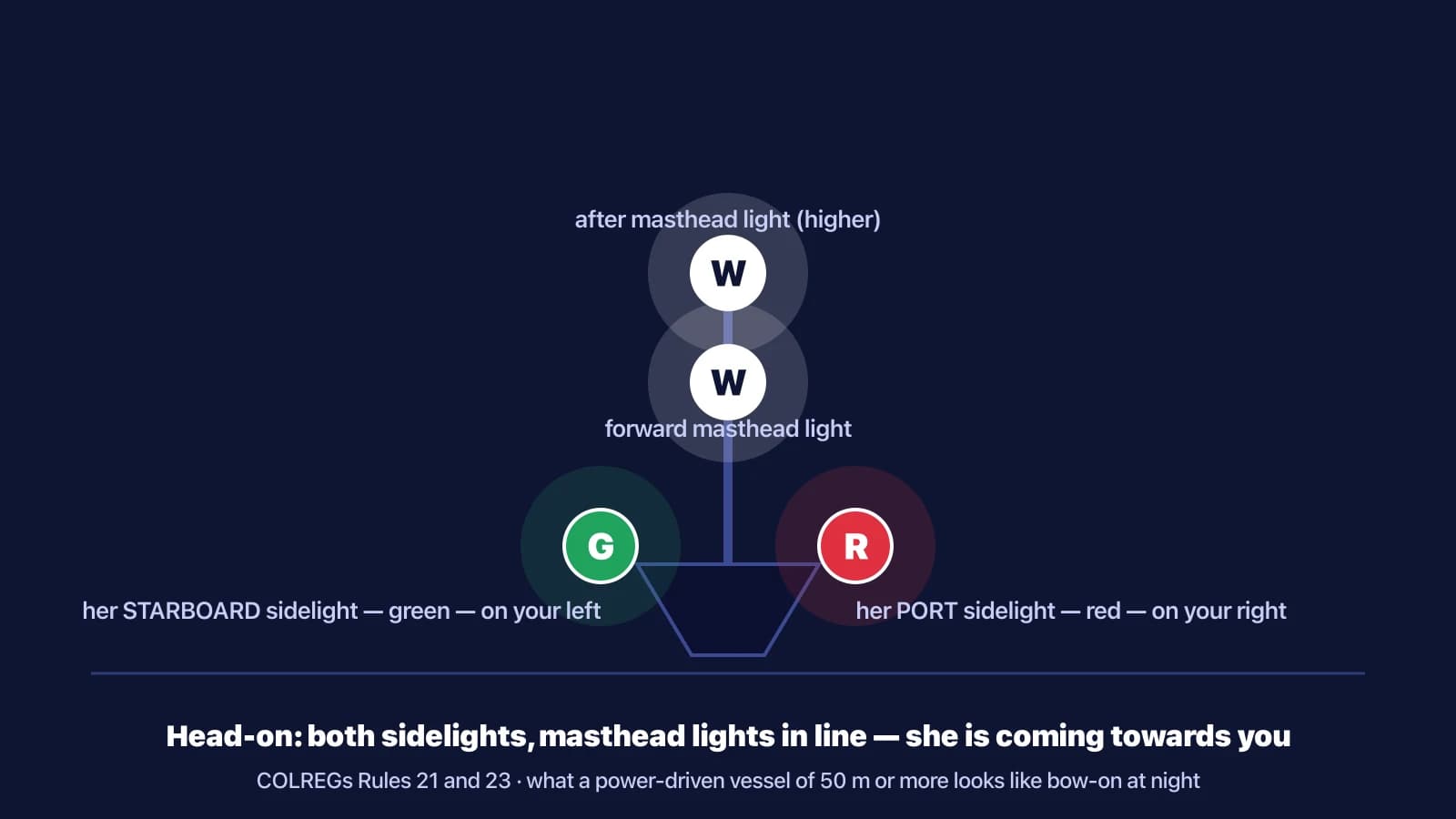
- Red and green together, masthead light(s) in line above: she is heading straight at you or nearly so. Identify what she is before deciding which rule applies.
- White only, low: probably a sternlight; she is going away or you are overtaking her — and if you are, you keep clear (Rule 13). It could also be an anchor light or a small craft, so watch it.
- Two white masthead lights, the after one higher: a power-driven vessel of 50 m or more. The two lights work like a gunsight — when they are vertically in line she is pointing at you; the more they open, the more she is angled away.
Power-driven versus sailing
A power-driven vessel underway shows a masthead light forward, sidelights and a sternlight; a vessel of 50 m or more must also show a second masthead light abaft of and higher than the first, and a shorter vessel may (Rule 23(a)). Small craft have alternatives. Under 12 m, a power-driven vessel may show an all-round white light and sidelights instead (Rule 23(d)(i) International; Inland Rule 23(c)). Under 7 m and with a maximum speed that does not exceed 7 knots, she may show only an all-round white light and shall, if practicable, also show sidelights (Rule 23(d)(ii)) — this depends on the boat's maximum speed, not the speed she happens to be doing, and it exists in the International Rules only; the U.S. Inland Rules have no white-light-only option.
Side views of three power-driven vessels with their prescribed lights.
A sailing vessel underway shows sidelights and a sternlight only (Rule 25(a)). Under 20 m she may combine them in one lantern at or near the top of the mast, the tricolour (Rule 25(b)). Any sailing vessel may add two all-round lights in a vertical line at or near the top of the mast, red over green, but not together with the tricolour (Rule 25(c)). Under 7 m she shall if practicable show the normal lights, but if she does not she need only have an electric torch or lit lantern ready to show in time to prevent collision (Rule 25(d)). A vessel under sail that is also being propelled by machinery shows the lights of a power-driven vessel and, by day, a cone apex down (Rule 25(e)).
Side views of sailing vessels: standard sidelights and sternlight, the tricolour option, and the optional red over green.
Lights that tell you what she is doing
Status lights are all-round lights in a vertical line. What a learner most often gets wrong is whether they replace or add to the basic lights, and the answer differs by category — so it is shown for each one below, from the rule text.
| Status | All-round lights | Day shape | With the basic lights? |
|---|---|---|---|
| Not under command (27(a)) | Red over red | Two balls | Making way: plus sidelights and sternlight. No masthead light. |
| Restricted in ability to manoeuvre (27(b)) | Red – white – red | Ball – diamond – ball | Making way: plus masthead light(s), sidelights and sternlight. At anchor: plus anchor lights. |
| Constrained by draught (28, International only) | Three reds (optional) | Cylinder | In addition to full power-driven vessel lights. |
| Trawling (26(b)) | Green over white | Two cones apexes together | Making way: plus sidelights and sternlight. Masthead light abaft and higher than the green: required if 50 m or more, optional below. |
| Fishing, not trawling (26(c)) | Red over white | Two cones apexes together | Making way: plus sidelights and sternlight. Gear more than 150 m out: an all-round white or cone apex up towards the gear. |
| Pilot vessel on duty (29) | White over red | — | Underway: plus sidelights and sternlight. At anchor: plus anchor light(s). |
| Towing astern (24(a)) | Two masthead lights in a vertical line (three if tow over 200 m) instead of the single masthead light; yellow towing light above the sternlight | Diamond if tow over 200 m | Plus sidelights and sternlight. Tow shows sidelights and sternlight. |
| At anchor (30(a),(b)) | One all-round white forward and a lower one aft; under 50 m one all-round white is enough | One ball | No sidelights, sternlight or masthead light. |
| Aground (30(d)) | Anchor light(s) plus red over red | Three balls | — |
Side views of a vessel not under command and a vessel restricted in her ability to manoeuvre with their light stacks.
Side views of a trawler and a fishing vessel with their light stacks.
Side view of a towing vessel and the vessel being towed.
Side views of a pilot vessel, an anchored vessel and a vessel aground.
Side view of a power-driven vessel constrained by her draught showing masthead lights, sidelights, sternlight and three all-round red lights.
If you see any of the status combinations, Rule 18 very probably makes you the give-way vessel: a sailing vessel keeps out of the way of vessels not under command, restricted in their ability to manoeuvre and engaged in fishing (Rule 18(b)), and every vessel other than NUC and RAM avoids impeding a vessel constrained by her draught (Rule 18(d)). An anchored vessel is not underway, and you simply keep clear of her.
Try it: which lights can you see?
Interactive: a slider moves the viewer around a chosen vessel type and shows exactly which lights are visible from each relative bearing, per the arcs in Rule 21.
How far away can you see them?
There is no single figure. Rule 22 sets minimum visibility ranges by vessel length and by type of light:
| Vessel length | Masthead light | Sidelights | Sternlight, towing light, all-round lights |
|---|---|---|---|
| 50 m or more | 6 | 3 | 3 |
| 12 m to under 50 m | 5 (3 if under 20 m) | 2 | 2 |
| Under 12 m | 2 | 1 | 2 |
The practical consequence: a small yacht's sidelights need only be visible at one mile, so by the time you can make out her red or green you may have only a few minutes. A ship's masthead lights, visible at six miles, usually give you time to take a bearing and work out her heading before her sidelights are in range. These are minimums for clear weather; rain, spray, background shore lights and your own height of eye all shorten them.
A method for reading any vessel
- Heading first. Red, green or both tells you which side you are looking at and roughly where she is going. A white light above the sidelights means power-driven.
- Count the whites. One masthead light: a power-driven vessel, probably under 50 m. Two, the after one higher: 50 m or more. Two or three in a vertical line: a tow.
- Look for a vertical column of coloured all-round lights. That is a status signal; identify it from the table and note whether it replaces or adds to the basic lights.
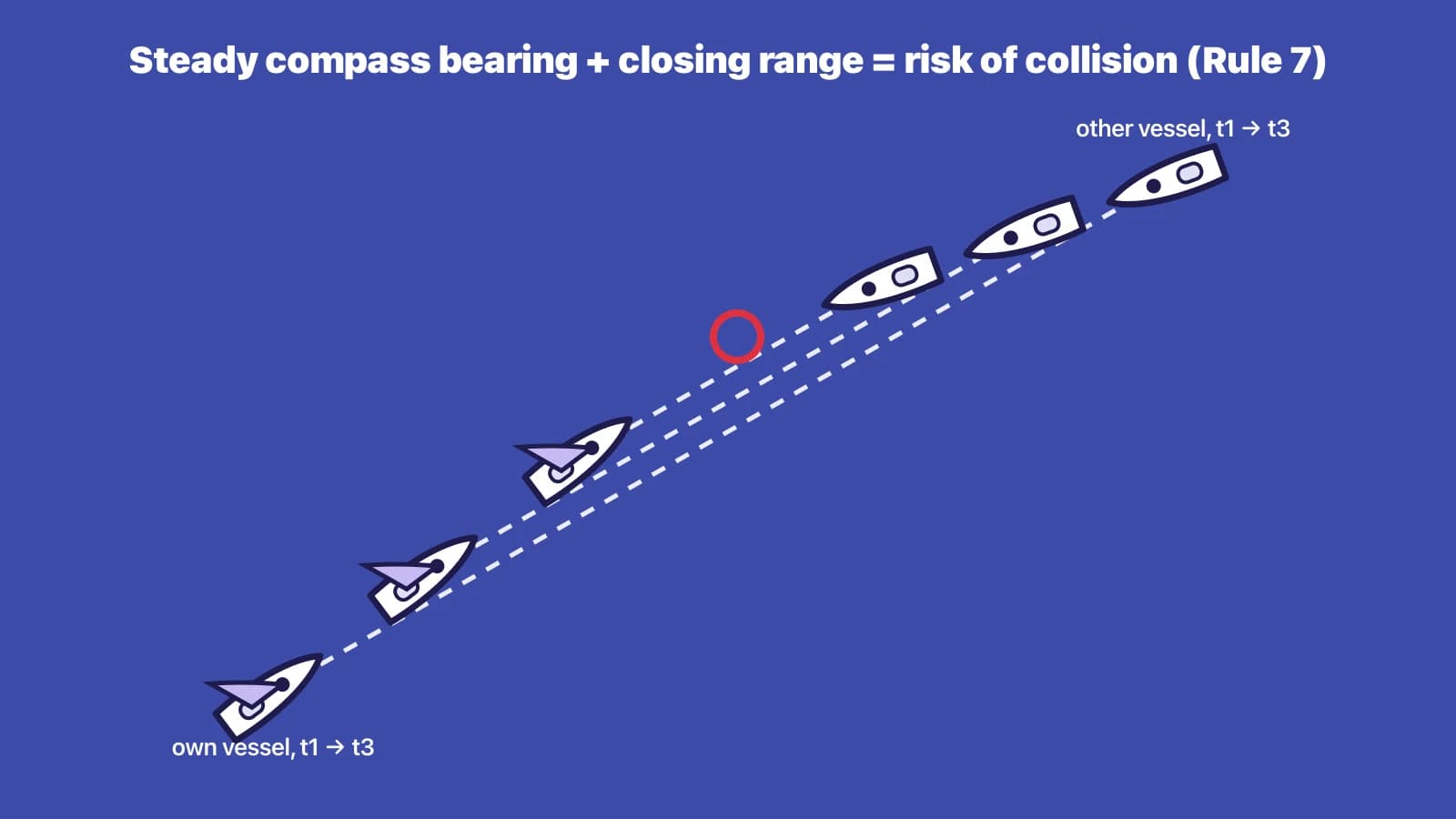
- Take a compass bearing and watch it for a minute or two. Steady bearing, closing range: risk of collision (Rule 7). A light that stays fixed against the shore is probably anchored.
- Only now decide which steering rule applies — Rules 12 to 18 for the encounter you have actually identified — and act early.
Check yourselfAhead at night you see, from top to bottom, a green all-round light, a white all-round light and, lower and off to one side, a red light. What is she and what does the red light tell you?Show answer
Green over white all-round is a vessel engaged in trawling (Rule 26(b)). The red light lower down is her port sidelight, so she is making way through the water (a trawler at rest shows only the green over white) and you are looking at her port side. Whether you are sailing or motoring, Rule 18 makes you keep out of the way of her — and she may be towing gear well astern.
Key takeaways
- Four basic lights: masthead 225°, sidelights 112.5° each, sternlight 135°, all-round 360°. The arcs are what make heading readable.
- A masthead light means machinery. Sailing vessels never show one; a yacht motor-sailing must.
- Small-craft exemptions are specific: under 12 m may use an all-round white plus sidelights; under 7 m with a maximum speed not over 7 knots may use the white alone (International only).
- Status lights combine with the basic lights differently: NUC adds sidelights and sternlight but no masthead light when making way; RAM adds masthead light(s) too; constrained by draught is added to full power-driven lights.
- Both sidelights visible means she is heading at you; it does not by itself make it a Rule 14 situation — that rule is for power-driven vessels.
- Visibility ranges are minimums set by length and light type (Rule 22), from 1 mile for a small vessel's sidelights to 6 miles for a ship's masthead light.