The International Regulations for Preventing Collisions at Sea (COLREGs, called the IRPCS in RYA courses) contain 41 rules plus annexes, but the encounters that decide exams and close-quarters situations come from a handful of them: Rules 12 to 18, the “conduct of vessels in sight of one another”. This guide follows the rules in the order they apply, explains what each one actually requires, and finishes with a reasoning sequence you can use on any question or any bearing that is not changing.
Before any steering rule: Rules 5, 7 and 8
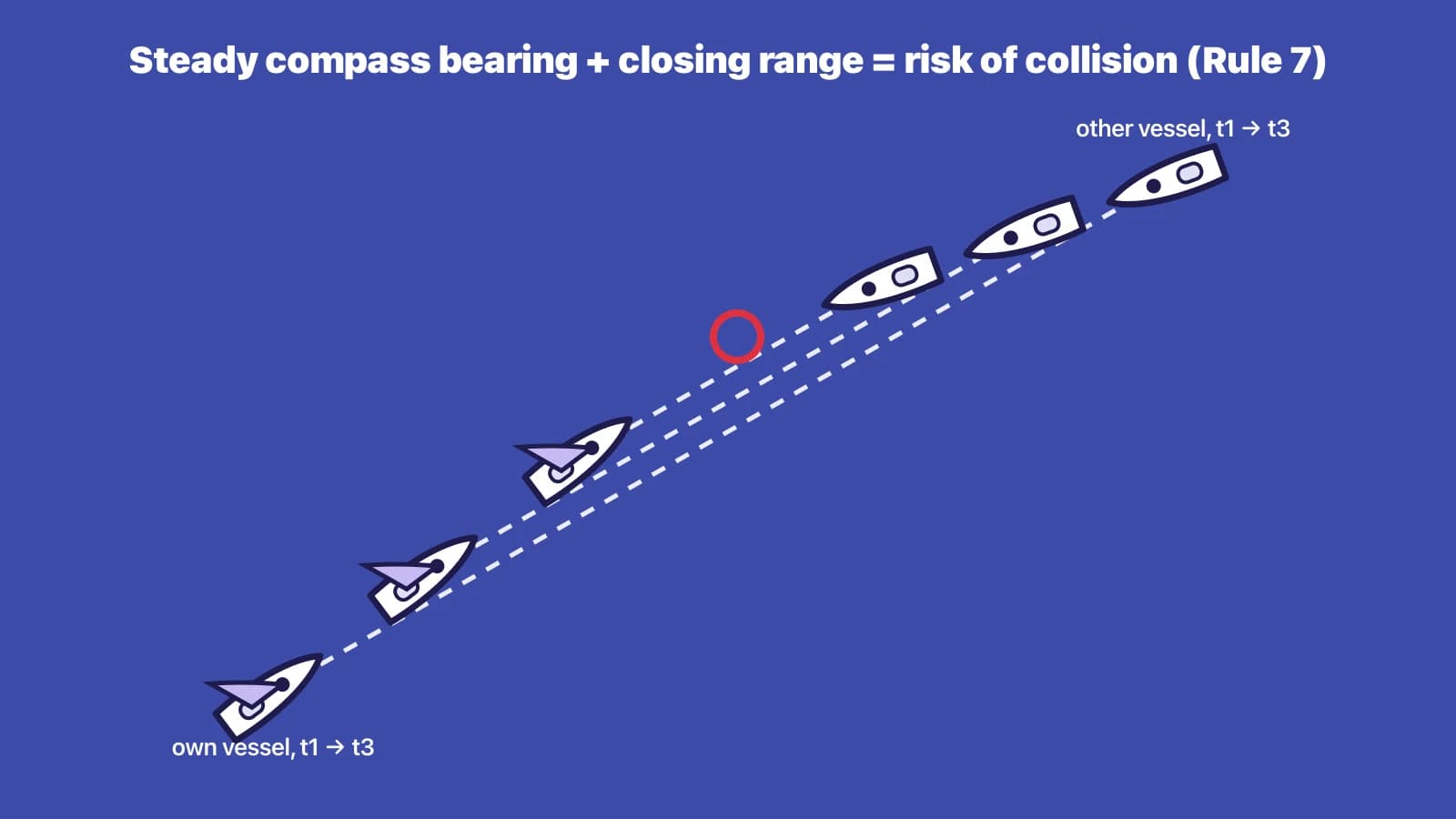
Every rule below assumes three things have already happened. You are keeping a proper look-out by sight and hearing and by all available means (Rule 5). You have decided whether risk of collision exists — if there is any doubt, it exists, and it is deemed to exist if the compass bearing of an approaching vessel does not appreciably change (Rule 7). And any action you take will be positive, made in ample time, large enough to be readily apparent to the other vessel, and checked until she is finally past and clear (Rule 8). Rule 8 also allows you to slow down or stop if you need more time to assess the situation.
Own vessel and another vessel at three successive positions, with parallel bearing lines between them converging on a collision point.
Rules 12 to 18 apply only to vessels in sight of one another (Rule 11). If you can see the other vessel only on radar, or you are in fog, Rule 19 applies instead and there is no give-way or stand-on vessel at all.
Rule 12 — two sailing vessels
Rule 12 applies only when both vessels are sailing vessels: under sail, with propelling machinery, if fitted, not being used (Rule 3(c)). A sailing boat with her engine running and in gear is a power-driven vessel, however much sail she has set.
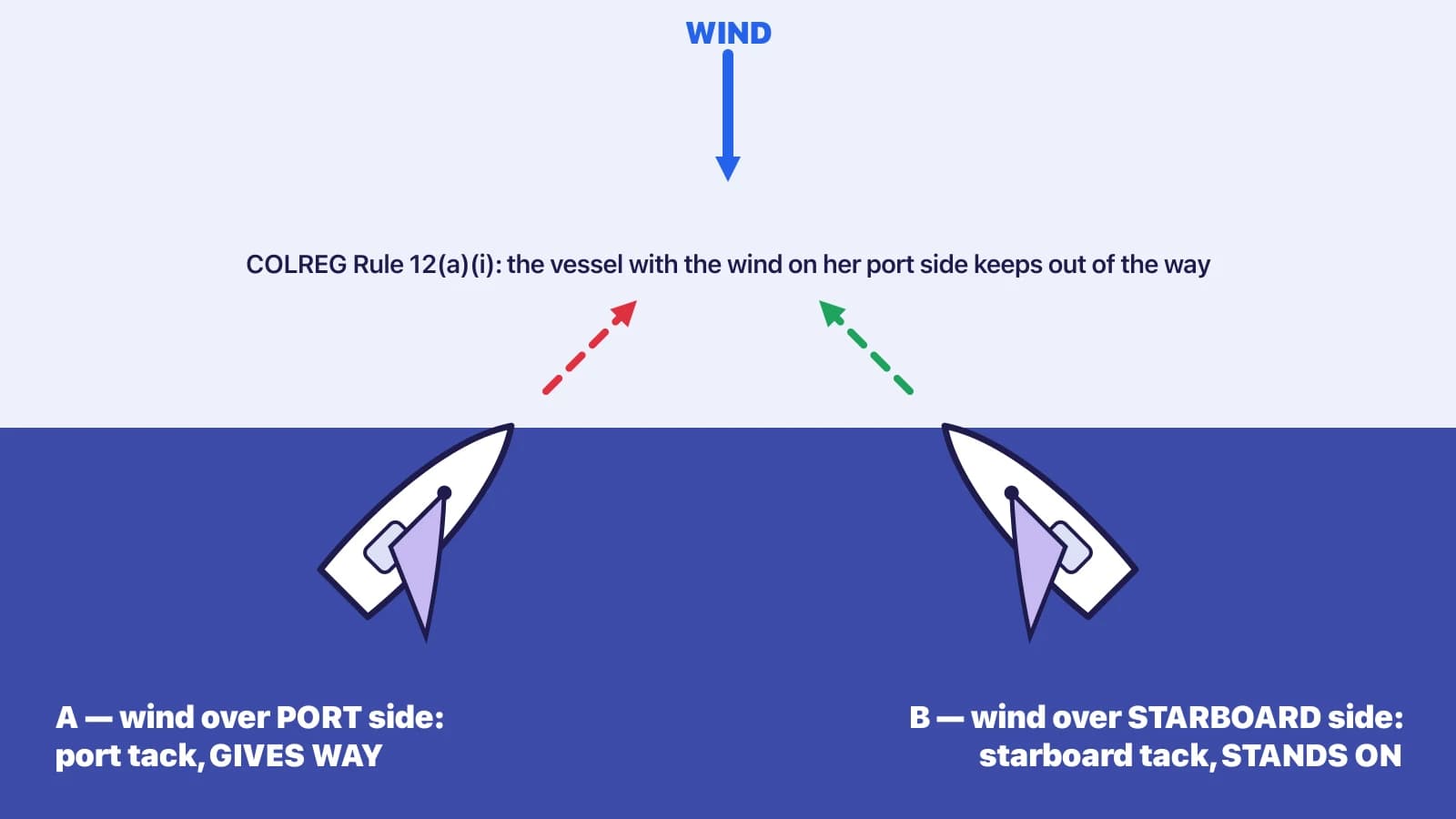
- Different tacks — Rule 12(a)(i): the vessel which has the wind on the port side keeps out of the way of the other.
- Same tack — Rule 12(a)(ii): the vessel which is to windward keeps out of the way of the vessel which is to leeward.
- Uncertain — Rule 12(a)(iii): if you have the wind on your port side and see a vessel to windward but cannot tell with certainty which side her wind is on, keep out of the way of her.
Your tack is decided by the wind, not by lights or by which way you are heading. Rule 12(b) makes it precise: the windward side is the side opposite to the one your mainsail is carried on. So if the boom is out to starboard, the wind is coming over your port side and you are on port tack. Look at your own boom, then at the other boat's boom, and you know both tacks.
Two sailing boats converging with the wind from above; the port-tack boat is labelled give-way and the starboard-tack boat stand-on.
Two sailing boats on the same tack, with the windward boat labelled give-way and the leeward boat stand-on.
“Port gives way” is a fine memory aid once you have understood the rule; it is not a rule about lights. It is easy to be on port tack while heading in any compass direction, and the other boat's sidelights tell you which side of her you are looking at, not what tack she is on.
Rule 13 — overtaking
Rule 13 overrides everything else in this section: “notwithstanding anything contained in the Rules of Part B, Sections I and II, any vessel overtaking any other shall keep out of the way of the vessel being overtaken.” Any vessel means any vessel — a yacht overtaking a fishing boat, a sailing dinghy overtaking a power boat. You are overtaking when you come up on another vessel from a direction more than 22.5° abaft her beam; at night, from a position in which you would see only her sternlight and neither sidelight.
A vessel with a shaded 135-degree sector centred on her stern and an overtaking boat inside it.
Two details are examined constantly. If you are in any doubt whether you are overtaking, Rule 13(c) says assume you are. And Rule 13(d): once you are the overtaking vessel, a later change in the bearing between you does not turn you into a crossing vessel or relieve you of the duty to keep clear until you are finally past and clear.
Rule 14 — head-on: power-driven vessels only
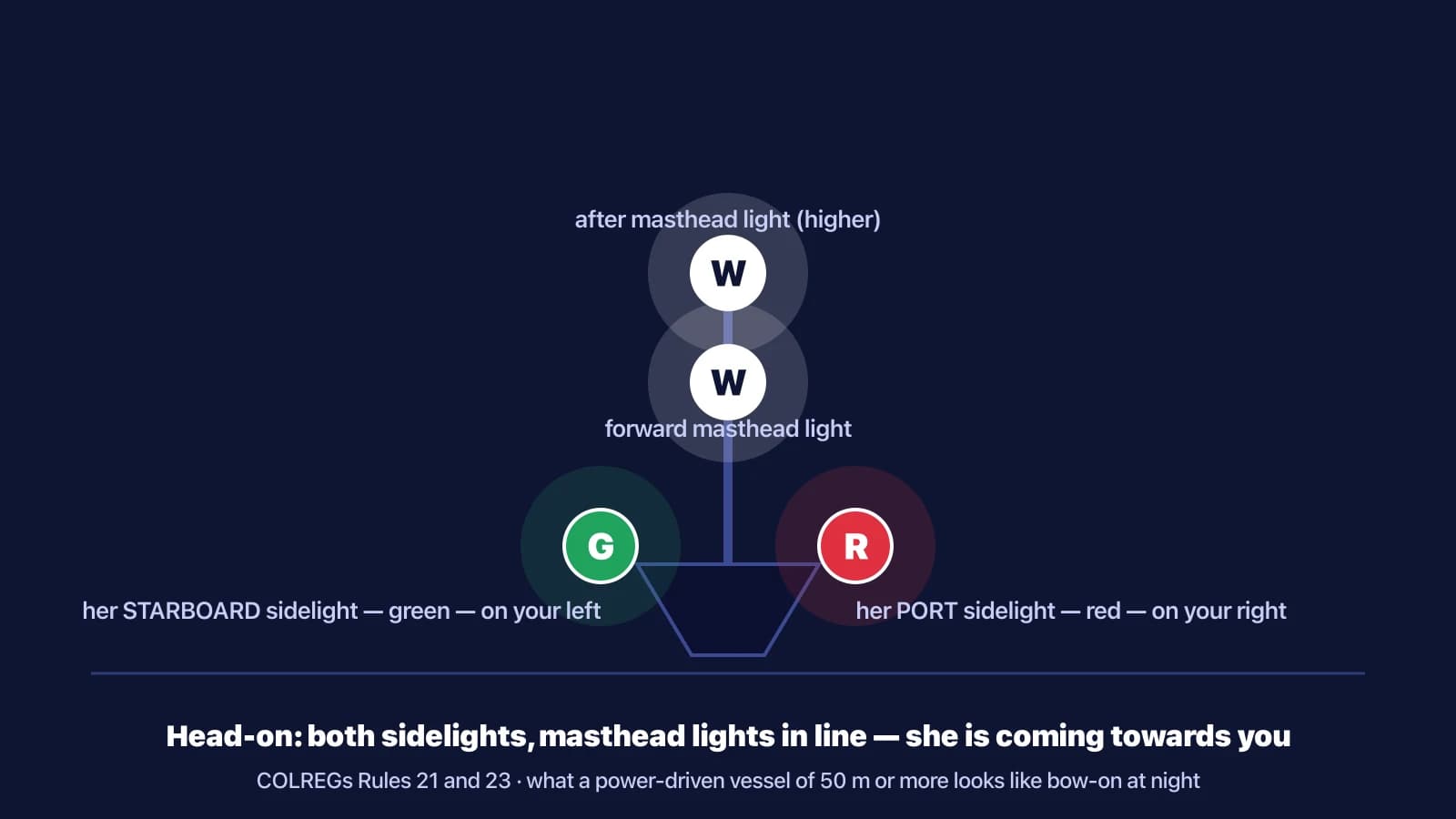
When two power-driven vessels meet on reciprocal or nearly reciprocal courses so as to involve risk of collision, each alters course to starboard so that each passes on the port side of the other. Both act; neither is stand-on. The situation is deemed to exist when you see the other vessel ahead or nearly ahead and, by night, could see her masthead lights in a line or nearly in a line and/or both sidelights. If in doubt, assume it is a head-on situation. (U.S. Inland Rule 14 adds “unless otherwise agreed”, because Inland vessels can agree a starboard-to-starboard passing by whistle or radio.)
Two power-driven vessels approaching head-on, each turning to starboard to pass port side to port side.
Rule 15 — crossing: power-driven vessels only
When two power-driven vessels are crossing so as to involve risk of collision, the vessel which has the other on her own starboard side keeps out of the way and, if the circumstances of the case admit, avoids crossing ahead of the other vessel. That is the whole rule. It does not say “turn to starboard”. A substantial early alteration to starboard to pass astern is usually the clearest way to comply, but the rule leaves the method to you: slowing down, stopping or a larger turn may be better in a narrow space or with other traffic around. What you must not do is make a small, late change, or cross ahead when you could have avoided it.
Two crossing power-driven vessels; the one with the other on her starboard side is labelled give-way and shown altering to starboard to pass astern.
Rules 16 and 17 — what give-way and stand-on actually mean
Rule 16 is one sentence: every vessel directed to keep out of the way shall, so far as possible, take early and substantial action to keep well clear. The two adjectives are the rule. Early means before the other vessel has to wonder what you are doing; substantial means a change she can see.
Rule 17 is the one candidates get wrong, because “stand-on” sounds like a privilege. It is a duty with three stages, and the stand-on vessel does not get to ignore the situation:
- Rule 17(a)(i): keep your course and speed. The give-way vessel is planning her manoeuvre around your predictability.
- Rule 17(a)(ii): you may take action to avoid collision by your manoeuvre alone as soon as it becomes apparent that the give-way vessel is not taking appropriate action. This is permission, not yet an obligation.
- Rule 17(b): when you find yourself so close that collision cannot be avoided by the give-way vessel's action alone, you shall take such action as will best aid to avoid collision. Now it is an obligation.
Rule 17(c) adds a specific caution: a power-driven vessel taking stage-two action in a crossing situation with another power-driven vessel shall, if circumstances admit, not alter course to port for a vessel on her own port side — because the give-way vessel is likely to be turning to starboard, and a turn to port would take you across her new heading. And Rule 17(d) closes the loop: none of this relieves the give-way vessel of her obligation to keep out of the way.
Rule 18 — responsibilities between vessels
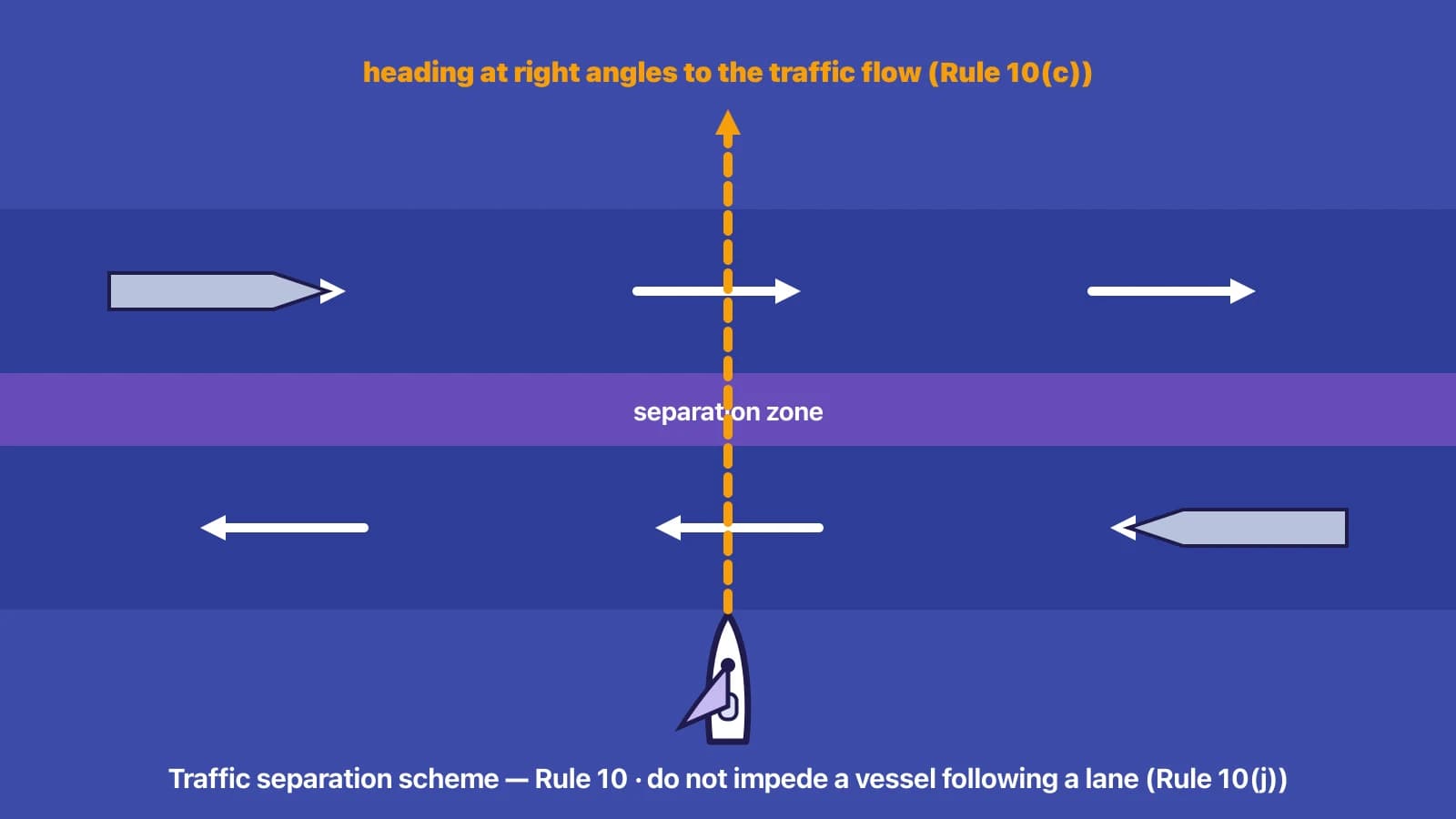
Rule 18 opens with the words that matter most: “Except where Rules 9, 10 and 13 otherwise require”. So overtaking, narrow channels and traffic separation schemes come first; only then does the list of vessel types apply. Each of the following keeps out of the way of every category above it:
| Vessel | Keeps out of the way of | Rule |
|---|---|---|
| Power-driven vessel underway | Not under command; restricted in ability to manoeuvre; engaged in fishing; sailing vessel | 18(a) |
| Sailing vessel underway | Not under command; restricted in ability to manoeuvre; engaged in fishing | 18(b) |
| Vessel engaged in fishing, underway | Not under command; restricted in ability to manoeuvre — “so far as possible” | 18(c) |
| Not under command / restricted in ability to manoeuvre | Rule 18 does not rank these two against each other | — |
Two categories are deliberately not in that list, and the rules treat them differently. A vessel constrained by her draught (Rule 3(h): a power-driven vessel severely restricted in her ability to deviate from her course because of her draught in relation to the available depth and width of water) is covered by Rule 18(d): any vessel other than one not under command or restricted in her ability to manoeuvre shall, if the circumstances of the case admit, avoid impeding her safe passage when she is showing the Rule 28 signals — three all-round red lights or a cylinder. “Avoid impeding” is a different, earlier duty from “keep out of the way” (see Rule 8(f)), and it does not make her stand-on if a risk of collision develops anyway. The constrained-by-draught category and Rule 28 exist only in the International Rules; the U.S. Inland Rules have no such vessel.
Seaplanes (Rule 18(e)) and wing-in-ground craft (Rule 18(f)) are the other special cases. A seaplane on the water keeps well clear of all vessels and avoids impeding their navigation, but where risk of collision exists she complies with the steering and sailing rules. A WIG craft keeps well clear of all other vessels only when taking off, landing and in flight near the surface; when operating on the water surface she is simply a power-driven vessel and follows the rules as one.
This is why “sail has priority” is a dangerous half-truth. A yacht spends much of her time in the exceptions: motoring in or out of harbour (a power-driven vessel), overtaking, in a channel where a laden ship cannot leave the fairway, or near a trawler with her gear down. Rule 18 puts a sailing vessel above a power-driven vessel only when she is genuinely a sailing vessel and none of Rules 9, 10 or 13 applies.
The common mistake: treating the rules as a ranking
Learners often memorise a single ladder — NUC at the top, power at the bottom — and try to read every encounter off it. The ladder is only Rule 18, and Rule 18 only applies after Rules 9, 10 and 13 have been considered, only in sight of one another, and only between vessels of different categories. Two sailing vessels use Rule 12; two power-driven vessels use Rule 14 or 15; any overtaking vessel uses Rule 13. Work through the questions in order, every time.
Six numbered steps for applying the steering and sailing rules in order.
Check yourselfYou are sailing on port tack. A yacht under sail on starboard tack is approaching from your starboard bow on a steady bearing. Who keeps clear, and what does the other boat do?Show answer
You do, under Rule 12(a)(i): you have the wind on your port side. Take early and substantial action to keep well clear (Rule 16) — tacking or bearing away behind her are the usual options. She keeps her course and speed (Rule 17(a)(i)) but must keep watching: if it becomes apparent you are not acting she may act, and if collision can no longer be avoided by you alone she must act. Note that “she is on my starboard side” is irrelevant here — that test belongs to Rule 15, which is for power-driven vessels.
Key takeaways
- The rules assign duties to both vessels; there is no right of way.
- Rules 12–18 apply only in sight of one another. In fog, Rule 19 applies and nobody is stand-on.
- Rule 13 (overtaking) applies to any vessel and overrides the rest of the section.
- Rule 12 is decided by the wind: port tack keeps clear of starboard tack; windward keeps clear of leeward on the same tack.
- Rules 14 and 15 are for power-driven vessels. Give-way must keep out of the way and avoid crossing ahead; the rule does not prescribe a particular turn.
- Rule 17 obliges the stand-on vessel to keep course and speed, permits her to act when the give-way vessel is clearly not acting, and requires her to act when collision can no longer be avoided by the give-way vessel alone.
- Rule 18 applies “except where Rules 9, 10 and 13 otherwise require”. Constrained-by-draught vessels are handled by “avoid impeding” under 18(d), not by the ranking, and only in the International Rules.