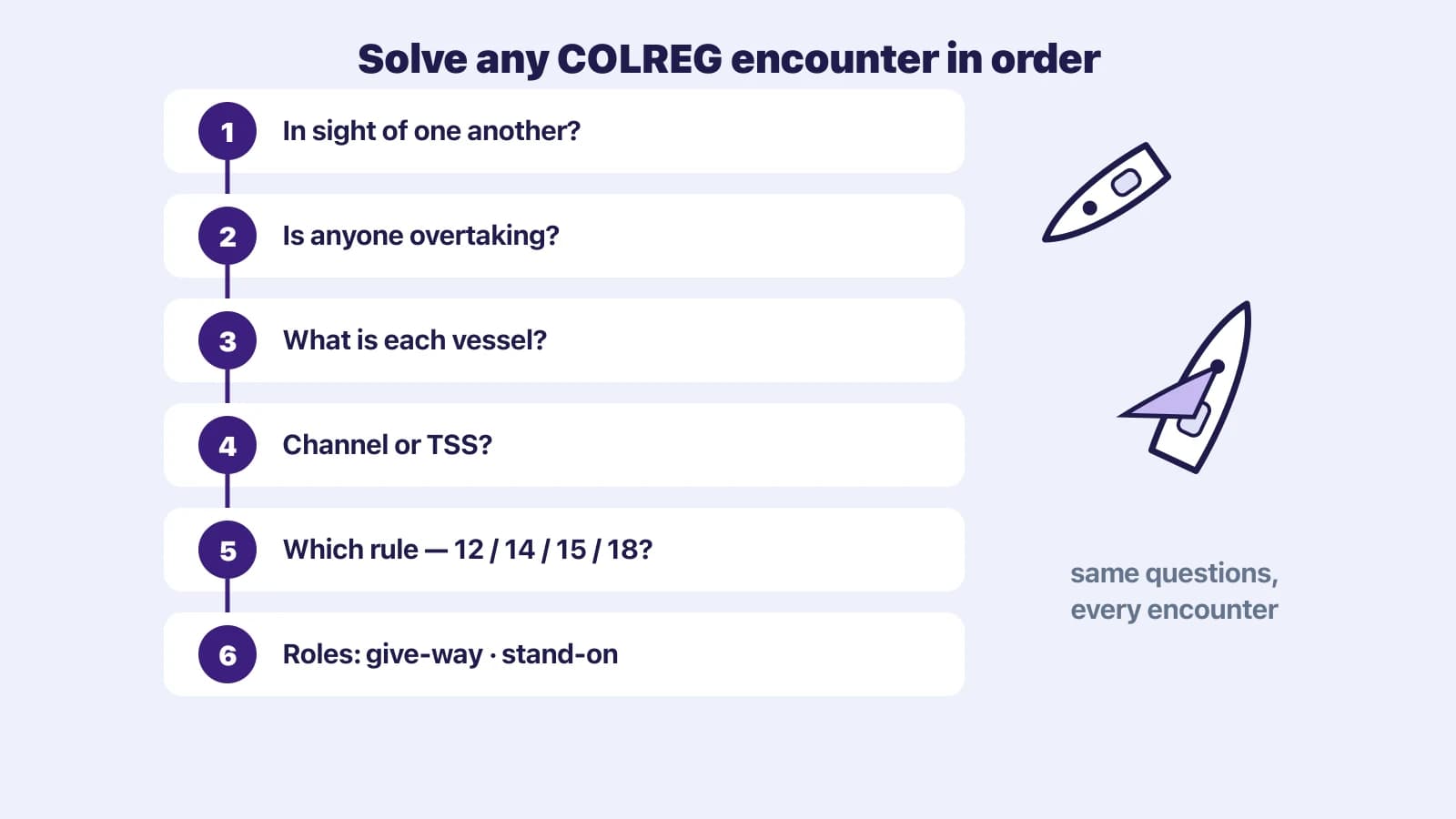
Our Rules 12–18 guide explains what each steering rule says. This guide is the drill for using them: the same eight questions, in the same order, for every vessel you see — in the exam and at the helm. The order is not a mnemonic; it is the structure of the rules themselves (Rule 11 limits Rules 12–18 to vessels in sight; Rule 13 says “notwithstanding anything” in them; Rule 18 opens “except where Rules 9, 10 and 13 otherwise require”).
Six-step decision sequence for applying the steering and sailing rules.
The eight questions
- In sight of one another? If you can only see her on radar or AIS, or fog hides her, Rules 12–18 do not apply — Rule 19 does, and nobody stands on. (Guide: Rule 19 and fog signals.)
- Is anyone overtaking? Coming up from more than 22.5° abaft the beam — the sternlight sector. If yes: Rule 13, the overtaker keeps clear whatever she is, and stays the overtaker until finally past and clear. If in doubt, assume yes.
- What is each vessel? Status, not appearance: a yacht under engine (even motor-sailing) is power-driven; lights and day shapes announce fishing, NUC, RAM, constrained by draught. Most wrong answers die at this step.
- Does geography rule? Narrow channel (Rule 9) or TSS (Rule 10): small craft and sailing vessels must not impede vessels confined to the channel or following a lane — an early duty that comes before any pecking order.
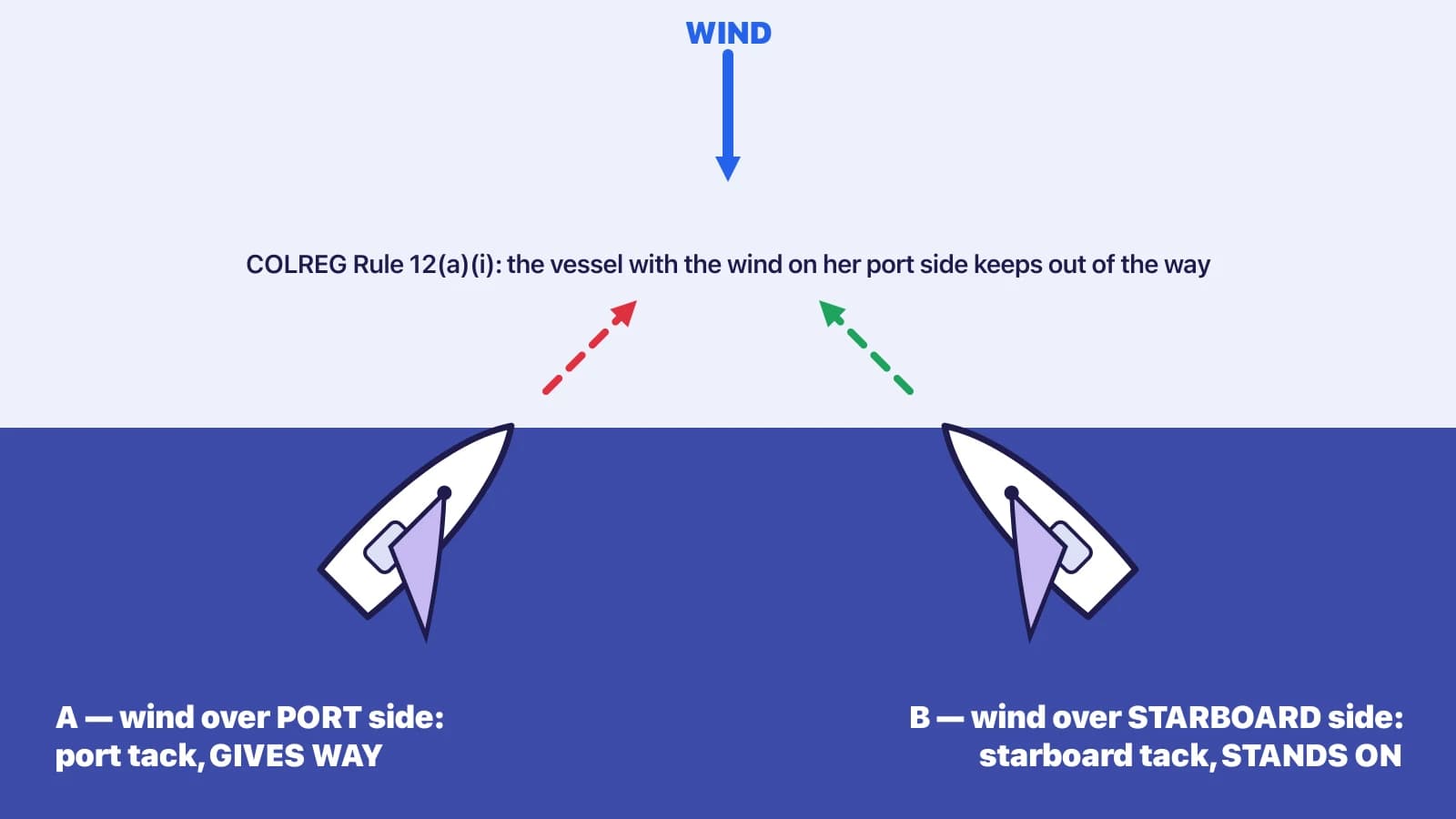
- Which encounter rule? Both sailing: Rule 12 (tack, then windward). Both power-driven: Rule 14 head-on or Rule 15 crossing. Different categories: Rule 18's list.
- Who keeps out of the way? Name the give-way vessel and her duty: early and substantial action, avoid crossing ahead in a Rule 15 crossing if circumstances admit.
- What must the stand-on vessel do? Rule 17's three stages: hold course and speed; may act when the give-way vessel clearly is not; must act when collision can no longer be avoided by the give-way vessel alone — and a power-driven stand-on vessel avoids turning to port for a vessel on her own port side.
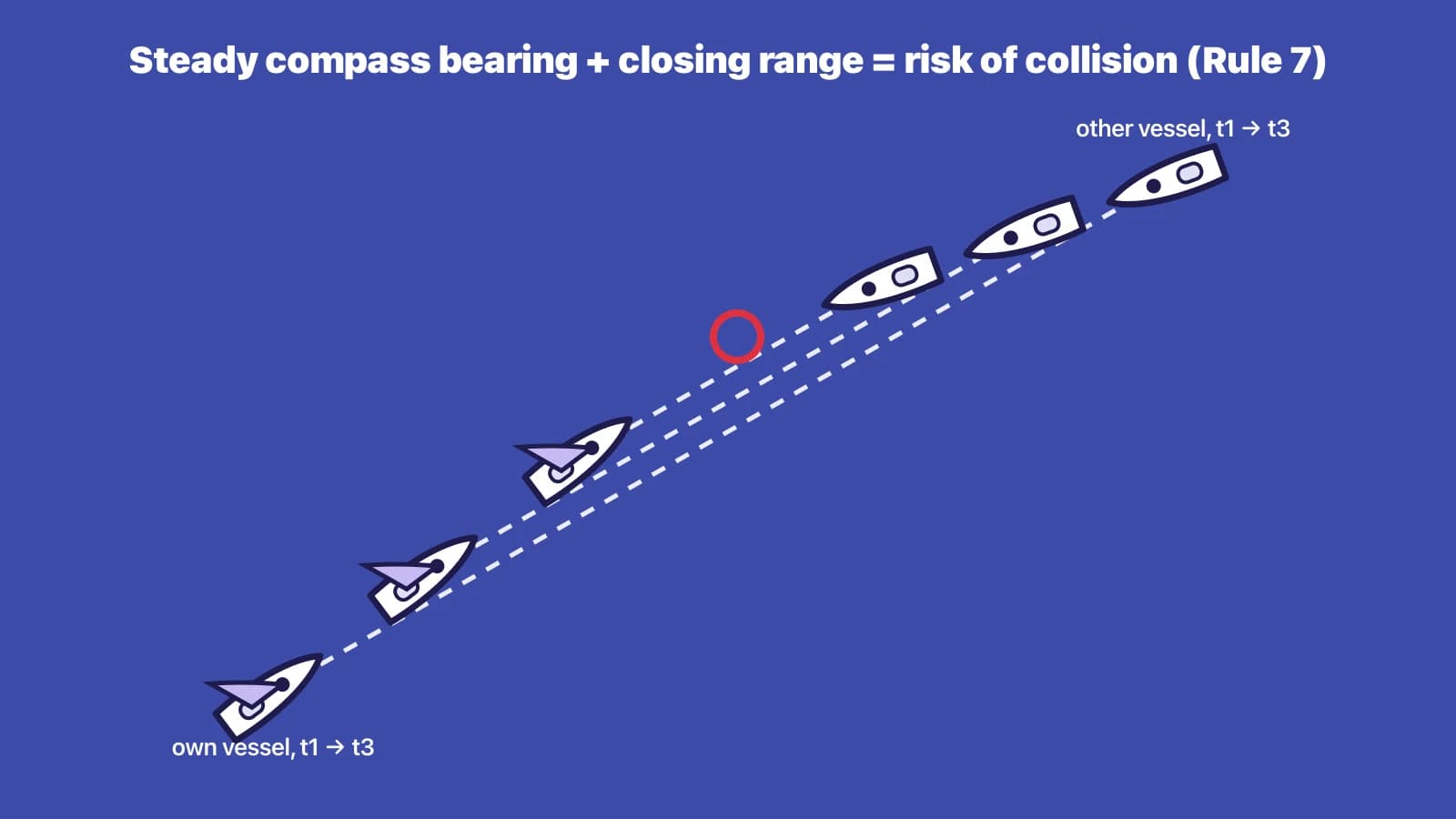
- Risk and adequacy. Is the bearing steady and range closing (Rule 7)? Is the action big, early, and visible (Rules 8, 16)? These two questions are always live, whatever the geometry.
Worked scenarios
Three plan views: sailing yacht with power vessel approaching from starboard; two sailing yachts on opposite tacks; a power vessel overtaking a sailing yacht from astern.
What would you do?1 · Close-hauled, power vessel to starboardYou are close-hauled under sail on starboard tack. A motor cruiser approaches steadily from your starboard bow; the bearing is not changing.Decide, then reveal the reasoning
In sight: yes. Overtaking: no — she is ahead of your beam. Types: you sailing, she power-driven. Channel/TSS: no. Rule: 18(a) — the power-driven vessel keeps out of the way of the sailing vessel. Note what did not matter: that she is to starboard. The “starboard side gives way” test lives in Rule 15, which is for two power-driven vessels; importing it here is the classic error. Your Rule 17 duty: hold course and speed, watch the bearing, be ready to act if she does not — and remember she may not have seen you.
What would you do?2 · The motor-sailer meets a yacht under sailYou are motor-sailing — main up, engine in gear — and converging with a yacht under sail alone on your port bow, steady bearing.Decide, then reveal the reasoning
Types first: you are power-driven (Rule 3(c): a sailing vessel is under sail with machinery not being used). So this is power vs sail: Rule 18(a), you keep out of the way, regardless of your sails and regardless of tacks. Act early and obviously (Rule 16): a substantial alteration astern of her, or slow down. Under sail alone it would have been Rule 12 and a tack comparison — which is why question 3 comes before question 5.
What would you do?3 · Two power vessels, lights at nightMotoring at night, you see a green sidelight and one white masthead light broad on your port bow, bearing steady, range closing.Decide, then reveal the reasoning
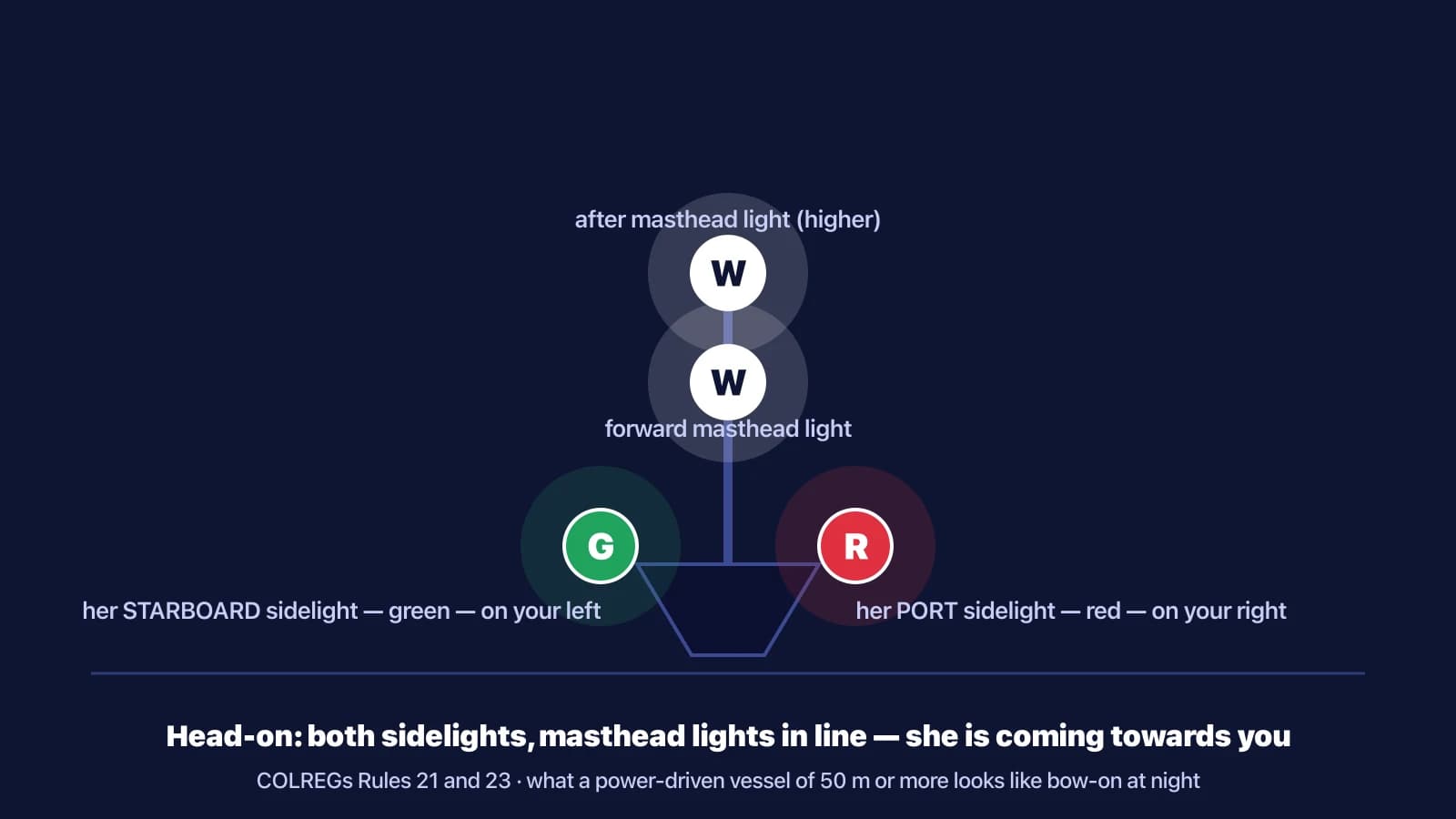
In sight: yes (you can see her lights). Overtaking: no. Types: her single masthead light above a sidelight says power-driven under 50 m; you are power-driven. Rule: 15, crossing. She shows you green — you are looking at her starboard side, so you are on her port bow… work it round: she has you on her port side, you have her on your port side? No: you see her green, so her starboard side faces you — she is crossing from your port to your starboard, and she has you on her starboard side. She is give-way; you stand on. Rule 17: hold course and speed, monitor; if she does not act, you may — avoiding a turn to port for a vessel on your port side. Five short blasts (Rule 34(d)) is the language for “I doubt you are acting”.
What would you do?4 · The channel and the coasterYou are beating up a buoyed channel in your 9-metre yacht, under sail. A loaded coaster is coming up the channel astern, confined to it by her draught.Decide, then reveal the reasoning
Question 4 fires before the pecking order: Rule 9(b) — a vessel under 20 m or a sailing vessel shall not impede the passage of a vessel that can safely navigate only within the channel. Your duty is early: tack out of the fairway or hold its edge so she never has to think about you. She is also overtaking (Rule 13) — but if you rely on that and force her to act, you have already failed 9(b). In a TSS the same logic is Rule 10(j). “Sail over power” has two exceptions written into Rule 18's first line, and this is one of them.
What would you do?5 · Red over white on a dark horizonSailing at night, you make out an all-round red over an all-round white light, and below them a green sidelight, converging slowly from starboard.Decide, then reveal the reasoning
Question 3 via lights: red over white all-round is a vessel engaged in fishing (not trawling), Rule 26(c); the green sidelight means she is making way, and you see her starboard side. Rule 18(b): a sailing vessel keeps out of the way of a vessel engaged in fishing. You are give-way: alter early and substantially — and give her gear a wide margin, since it can extend far from the hull (a white all-round light or cone would mark gear over 150 m out). If the lights had been green over white (trawling) the answer would be the same; white over red (pilot) or red-white-red (RAM) would each send you back through the list.
Try it: is the bearing changing?
Interactive: two converging vessels over time, with a live bearing readout, showing a steady bearing when neither alters and a changing bearing after an early substantial alteration.
Using the method in exams
- Write the eight answers, however obvious — examiners award the reasoning, and the discipline catches the planted trick (an engine mentioned in passing, a shape you skimmed).
- Answer in the rules' vocabulary: “keep out of the way”, “stand-on”, “early and substantial action”, “not impede” — not “has right of way”, which appears nowhere in the International rules.
- If two rules seem to conflict, the priority order is the structure: Rule 13 over the encounter rules; Rules 9 and 10 qualify Rule 18; Rule 2 (responsibility) allows departure only when necessary to avoid immediate danger.
- For lights questions, do question 3 from the lights first, then continue the method — our navigation-lights guide is the reference.
Check yourselfA paddleboarder is crossing ahead of your yacht under sail. Nothing about paddleboards appears in Rules 12–18. What does the method give you?Show answer
Question 3 with the definitions: a paddleboard is a vessel under oars in some jurisdictions' interpretation, or simply a vessel (Rule 3(a): every description of water craft used as a means of transportation on water) — not a sailing vessel and not power-driven, so the specific encounter rules do not name her. That points to Rule 2 (ordinary practice of seamen) and Rules 5–8: keep your look-out, judge risk on the bearing, and take early, substantial, obvious action to pass at a safe distance — the burden falls on the vessel that can manoeuvre, which is you. The method's value is knowing when you are outside the named encounters and defaulting to good seamanship, not inventing a hierarchy.
Key takeaways
- Eight questions, fixed order: in sight → overtaking → types → channel/TSS → encounter rule → give-way duty → stand-on duty → risk and adequacy.
- Status beats appearance: engines make you power-driven; lights and shapes declare the special categories.
- Geography (Rules 9/10) and overtaking (13) outrank the Rule 18 list — by the rules' own words.
- Stand-on is a job with three stages, not a privilege; give-way action must be early, substantial and visible.
- When no named rule fits, Rules 2 and 5–8 still do.