Every first-level course — RYA Competent Crew, ASA 101, US Sailing Basic Keelboat — says the same thing: no experience necessary. That is true. It is also true that the first morning is a lot of new words at once, and that the people who enjoy it most are the ones who arrive knowing a dozen of them. This guide is deliberately short. Read it twice, tie the three knots, and you are prepared.
The boat, in twelve words
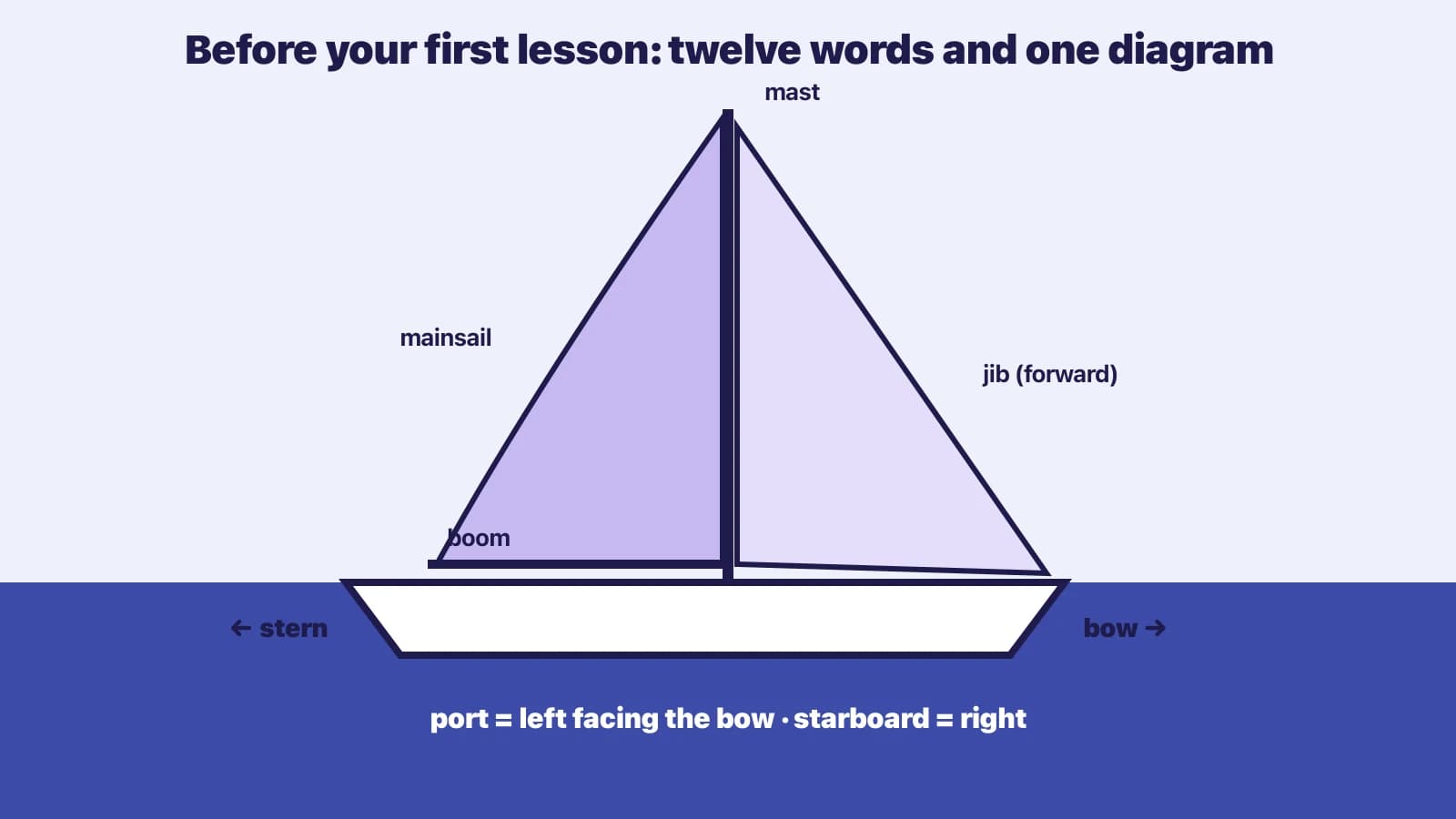
- Bow — the front. Stern — the back. Forward and aft are the directions.
- Port — the left side when you face the bow. Starboard — the right side. These never change, whichever way you are facing. (Port and left both have four letters.)
- Hull — the body. Keel — the fin underneath that stops you sliding sideways and, on a keelboat, keeps you upright. Rudder — the blade at the back that steers; the tiller or wheel moves it.
- Mast — the vertical pole. Boom — the horizontal pole along the bottom of the mainsail, which swings across the boat and is the thing to keep your head clear of.
- Mainsail — the big sail behind the mast. Jib (or genoa if it is large) — the sail in front of the mast.
- Sheets — the ropes that pull the sails in and let them out. Halyards — the ropes that hoist the sails up. Lines — what ropes are called once they have a job.
Wind words
Windward is the side the wind is coming from; leeward (say “loo-ard”) is the side it is going to. Upwind means towards the wind, downwind away from it. Your tack is named for the side the wind is on: wind over the starboard side is starboard tack, and the boom is then out to port. Instructors will say “heading up” for turning towards the wind and “bearing away” for turning away from it. Those two phrases will be used all day.
Points of sail — the one diagram to learn
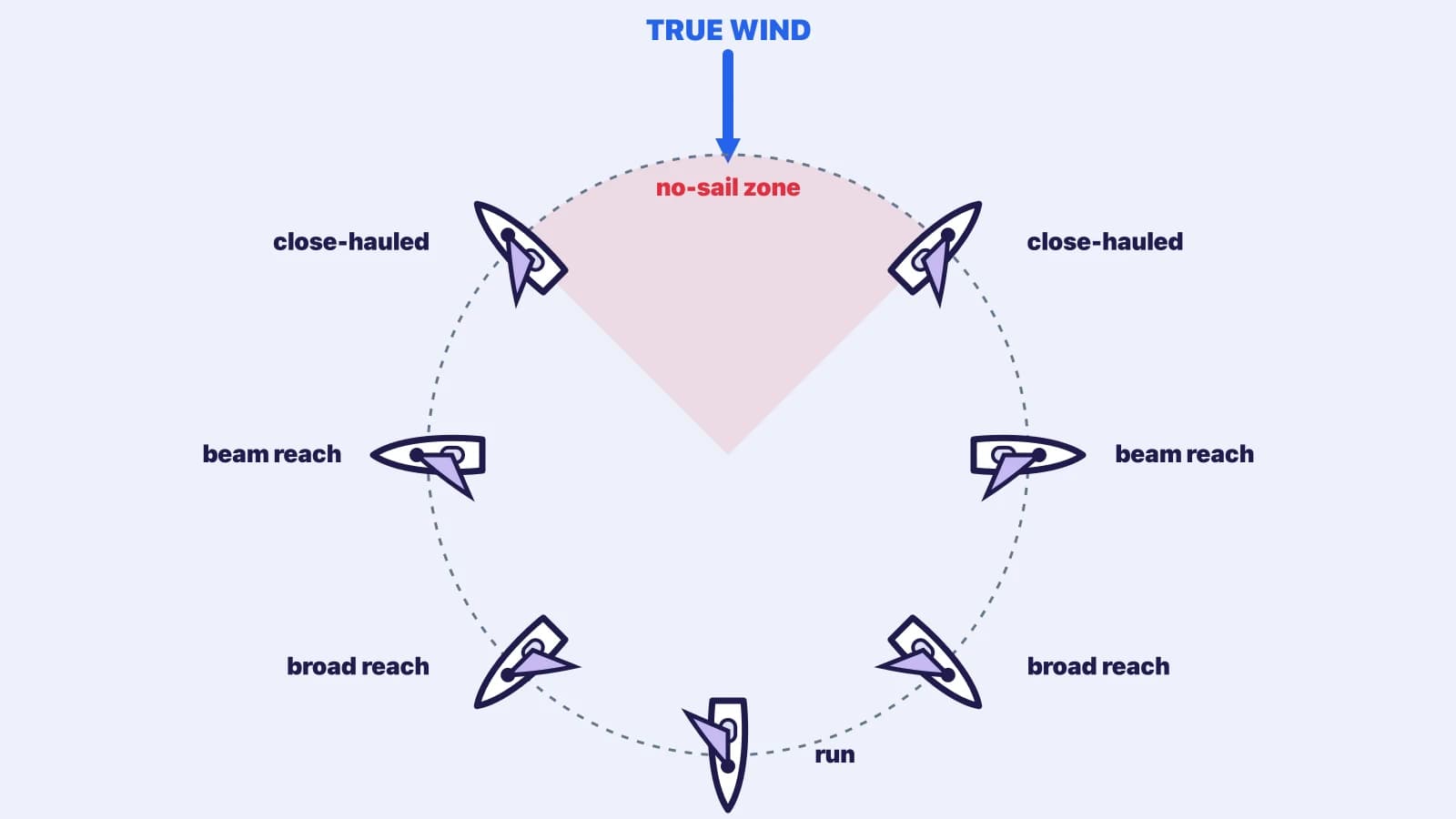
Boats arranged around a circle showing close-hauled, close reach, beam reach, broad reach and run on both tacks, with a no-sail zone into the wind.
The simplest rule you will hear: the further you turn away from the wind, the further you let the sails out. Sails in tight going upwind; sails right out going downwind. If a sail flaps, it is out too far for the course you are on (or you are pointing too high); pull it in until it stops. That one habit — flap means pull in — carries you through the first day.
The two turns
- Tacking: turning the bow through the wind, from one tack to the other. The sails pass across the boat as it goes through the no-sail zone. Commands you will hear: “Ready about?” — “Ready” — “Lee-oh!” (RYA) or “Ready to tack?” — “Ready” — “Hard alee!” (ASA).
- Gybing (jibing): turning the stern through the wind, so the boom swings across from behind. It is faster and the boom comes across with force, which is why it is done deliberately and with a warning: “Ready to gybe?” — “Ready” — “Gybe-oh!” / “Jibe ho!”. Keep your head below boom height whenever the boat turns.
Basic safety: what you will be told, so it is not a surprise
- Wear the lifejacket or buoyancy aid the school gives you, done up, all the time you are on deck. Nobody will think less of you.
- One hand for yourself, one for the boat: hold on when you move around.
- The boom is the main way beginners get hurt. Stay low when the boat turns, and never stand in the boom's path during a gybe.
- Keep fingers out of the gap between a line and a winch or cleat under load. Lines under load can cut.
- If someone falls in, shout “man overboard”, point at them and keep pointing. The skipper does the rest; your job is not to lose sight of them.
Three knots
Bring a metre of rope and learn these from a video or a friend, in the order given. You will use all three on day one: a figure-eight in the end of every sheet so it cannot run out; a bowline to make a loop that will not slip; and a cleat hitch to make a mooring line fast. Our knots guide explains what each is for and how it fails, and lists the full beginner set.
A rope with its standing part, working end and a loop labelled.
What not to worry about yet
- Sail trim beyond “flap means pull in”. Telltales, twist and traveller come later, and mean nothing until you have felt the boat.
- The collision regulations in full. For a first lesson you need one idea: keep a look-out and tell the instructor about every boat you see.
- Navigation, tides, charts, weather theory. All ashore, all later, all easier once you have been on the water.
- Every name for every part. Learn the twelve above. The rest arrive by themselves.
- Being seasick, being scared, or being slow. All normal, all temporary, and every instructor has seen them a thousand times.
Check yourselfThe instructor says: “We're on starboard tack. Ready about? … Lee-oh.” What is about to happen, where is the boom now, and where will it be afterwards?Show answer
The boat is about to tack: the bow will turn through the wind. On starboard tack the wind is over the starboard side, so the boom is out to port now. After the tack the boat will be on port tack, with the wind over the port side and the boom out to starboard. Keep your head down as it crosses, and be ready to swap sides.
Key takeaways
- Twelve words: bow, stern, port, starboard, hull, keel, rudder, mast, boom, mainsail, jib, sheets/halyards.
- Windward, leeward, tack, heading up, bearing away.
- Points of sail: further off the wind, sails further out. Flap means pull in.
- Tack = bow through the wind; gybe = stern through the wind, boom comes across hard.
- Lifejacket on, one hand for the boat, head below the boom. Three knots: figure-eight, bowline, cleat hitch.