A sailing boat cannot sail straight into the wind, and it does not simply get blown downwind. Everything in between is available, and the points of sail are the names for the angles. That is the easy half. The half that confuses people for years — why the wind seems to move forward and strengthen as you speed up — is a single vector addition. This guide does both, and gives you an interactive model to play with.
The points of sail
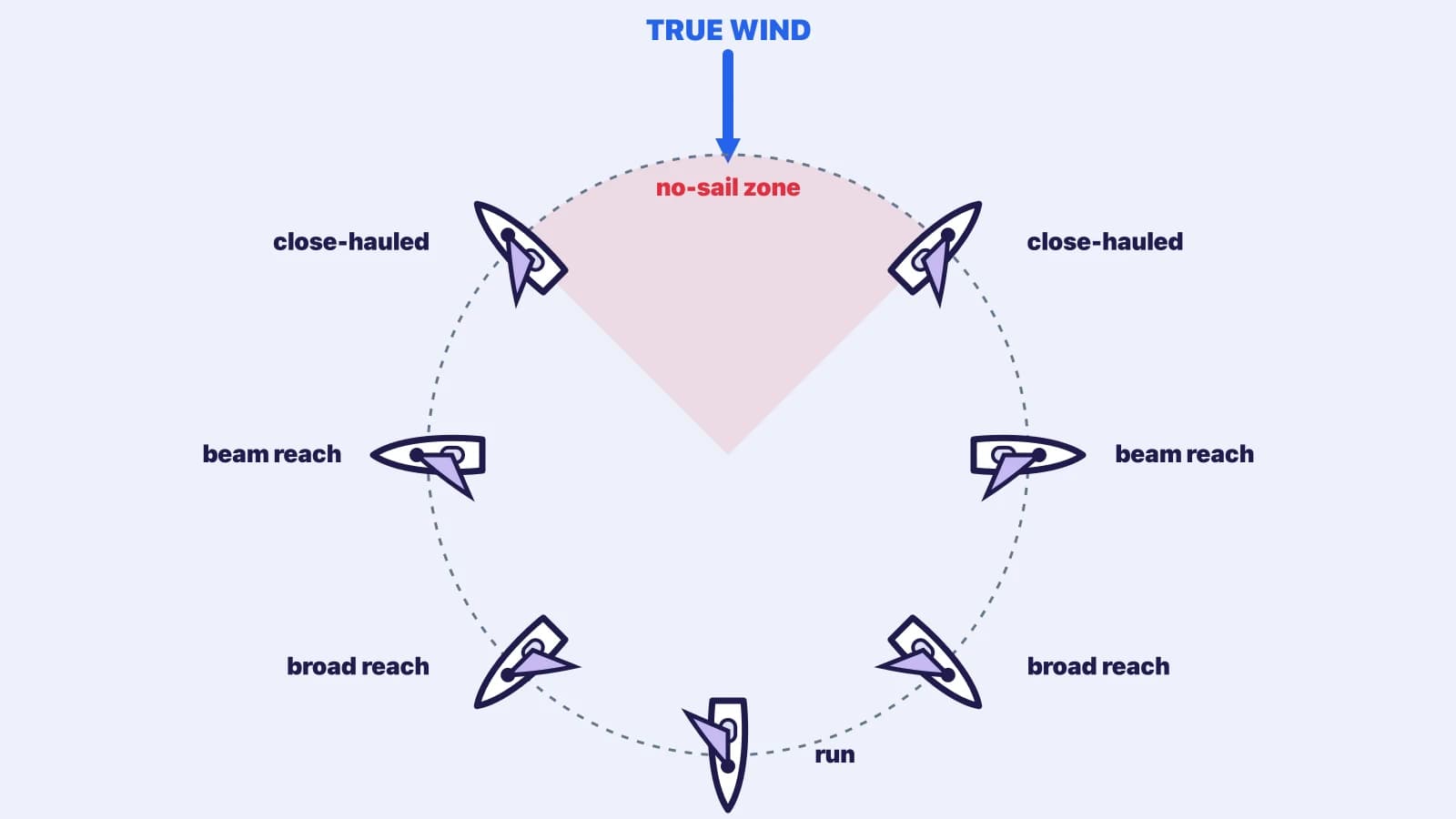
Circle of boats showing the five points of sail on both tacks with a no-sail zone into the wind.
- No-sail zone: roughly 40–45° either side of the true wind for typical boats (it varies by boat and rig). To go upwind you sail close-hauled on one tack, then the other — beating.
- Close-hauled: as close to the wind as the boat sails well, sails sheeted in tight. ASA's guidance: about 45° to the true wind for most boats.
- Close reach: between close-hauled and a beam reach; sails eased a little.
- Beam reach: wind on the beam, sails about half out. For many boats the fastest and most comfortable point of sail.
- Broad reach: wind over the quarter, sails well out.
- Run: wind astern, sails right out; the headsail may collapse behind the main (goosewinging or a pole fixes that). Steering needs care because an unintended gybe is possible — see the first-lesson guide.
The trimming rule that falls out of the diagram: the further off the wind you point, the further out the sails go. And its inverse, the beginner's compass: if a sail flaps, either sheet in or bear away; if the boat heels too much and fights you, ease out or head up.
True wind, apparent wind
The true wind is the wind over the water — what a moored boat feels. The apparent wind is what your moving boat feels, and it is what the sails, the masthead vane and your face all experience. The relationship is pure vector addition: your motion through the air creates a headwind equal and opposite to your velocity, and the apparent wind is the true wind combined with that headwind. (Meteorologists write it the other way round: true wind = apparent wind + vessel motion.)
Three vector triangles showing apparent wind as the sum of true wind and the boat's headwind on close-hauled, beam reach and broad reach.
- Upwind, apparent wind is stronger than true and further forward. A 12-knot true wind can feel like 16 knots close-hauled.
- Downwind, apparent wind is lighter than true. The same 12 knots on a run can feel like 7 — which is why crews are surprised by the wind when they turn round to come home.
- Any acceleration moves the apparent wind forward; any deceleration lets it swing aft. Gusts do the reverse: a gust is extra true wind, so the apparent wind swings aft in a gust before the boat speeds up (a lift on both tacks), then creeps forward again.
- You trim to the apparent wind, because that is the air the sail is standing in. This is why fast boats (catamarans, iceboats) sheet in hard even on a broad reach: their own speed drags the apparent wind far forward.
Try it: points of sail and apparent wind
Interactive: a slider sets the boat's heading relative to the wind; the diagram shows the point of sail and the true, boat and apparent wind vectors with computed apparent wind speed and angle.
Three places this bites in real sailing
- The trip home. You reach downwind all afternoon in what feels like a gentle breeze, turn for home, and discover an upwind slog in 6 knots more apparent wind than you had noticed. Check the true wind before deciding how far downwind to go.
- Reefing decisions. Wind limits that matter to the boat are about wind over the sails — apparent. A forecast gives true wind; upwind you will feel more than the forecast number, downwind less. Our reefing guide builds on this.
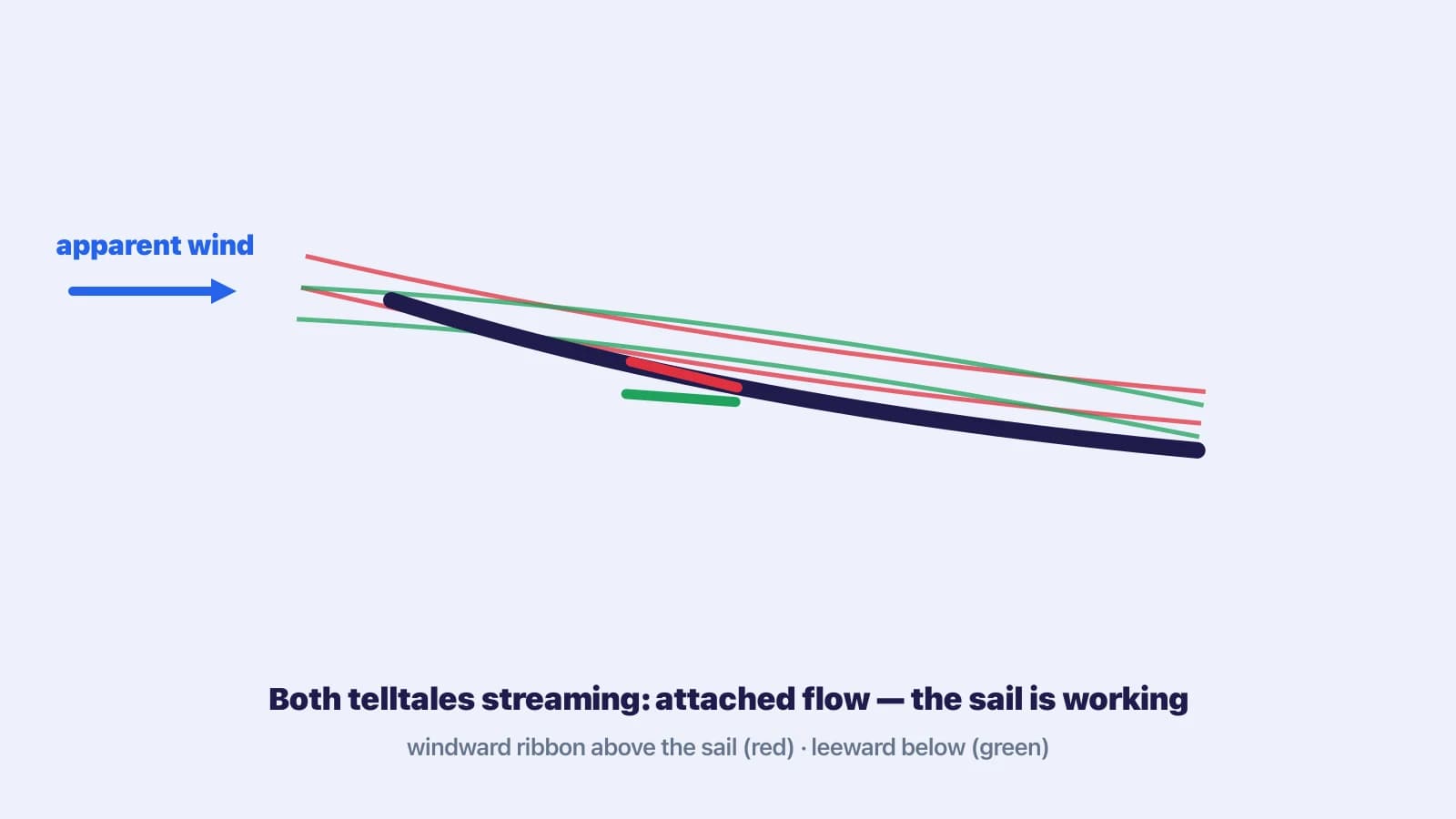
- Instruments. Wind instruments measure apparent wind and calculate true from boat speed. If your speed input is wrong (paddlewheel fouled), the 'true' wind readout is wrong too. Points-of-sail diagrams are in true wind; your telltales live in apparent.
What would you do?The vanishing breezeYou are on a run in what your instruments say is 14 knots of true wind, making 6 knots of boat speed. The wind feels light — about 8 knots on your face — and the crew suggest shaking out the reef and relaxing. In half an hour you must turn 150° to starboard and beat home.Decide, then reveal the reasoning
The 8 knots you feel is apparent: true wind minus most of your boat speed. When you turn to close-hauled, the apparent wind will be roughly true wind plus a good part of your boat speed — around 18–19 knots over the deck, more in gusts. That is a completely different boat: reef before the turn, while the motion is easy, not after. The wind did not change; your direction did.
Check yourselfSailing close-hauled at 5 knots in 10 knots of true wind, a gust hits. Before the boat accelerates, which way does the apparent wind swing, and what do your telltales show?Show answer
Aft. The gust adds true wind, which comes from further off the bow than your self-made headwind, so the combined apparent wind rotates aft — you are momentarily lifted, and the windward telltales may lift as the angle of attack opens if you do not head up or the boat does not accelerate. As the boat speeds up, the apparent wind creeps forward again. This aft-then-forward swing is why helms luff gently into gusts.
Key takeaways
- Five named points of sail per tack, plus a no-sail zone of roughly ±40–45°. Further off the wind = sails further out.
- Apparent wind = true wind combined with the headwind of your own motion. Stronger and further forward upwind; lighter downwind.
- You trim and steer to apparent wind; diagrams and forecasts speak true wind. Know which one you are looking at.
- Gusts swing the apparent wind aft; acceleration pulls it forward.