RYA Day Skipper Theory — the RYA also calls it the Day Skipper Shorebased course — is a theory course aimed at prospective yacht skippers and inexperienced crew. It introduces chartwork, navigation, meteorology and the basics of seamanship, and its stated goal is to prepare you to make the key decisions needed to skipper a small vessel in familiar waters. It is open to anyone; some practical experience is desirable but not required, and there is no minimum age. SailQuiz is an independent study aid and is not affiliated with or endorsed by the RYA; for the definitive syllabus and assessment details, talk to an RYA training centre.
Theory, practical and commercial endorsement are three different things
- Day Skipper Theory (Shorebased): 40 hours plus exam time, in a classroom, online or by distance learning. The exam must be invigilated at an RYA training centre, however the course is delivered. Passing it gives you a shorebased certificate: evidence of theory knowledge, not a licence to skipper.
- Day Skipper Practical: five days on board (or three weekends, or 3 + 2 days), minimum age 16, with prerequisites of basic sailing ability, 5 days, 100 miles and 4 night hours at sea, and theory knowledge to shorebased level. You are tested on elements of the theory during the course. It is this certificate that the RYA describes as showing charter companies you can take a boat out safely, and that qualifies you to apply for an ICC.
- Commercial endorsement: if you want to use Day Skipper to work on a commercial vessel under the MCA codes of practice, the RYA requires both the shorebased certificate with an invigilated exam and the practical certificate, plus the endorsement process. This is a separate step with its own conditions.
So completing the theory course alone does not make you a Day Skipper in the sense that a charter company or the ICC scheme recognises. It makes you ready for the practical course, which is where the qualification is assessed.
What the course covers
The RYA lists the course content as seamanship; coastal navigation and pilotage; chartwork; electronic charts; position fixing; plotting a course to steer; weather forecasting and meteorology; tides; and collision regulations. In practice, each heading breaks down into things you need to be able to do to a practical standard, not write essays about:
| RYA course content | What you need to be able to do |
|---|---|
| Seamanship | Name the parts of the boat and rig; choose and tie the right knot; anchor and weigh, understand scope and holding; personal safety equipment, distress signals, fire and man overboard |
| Coastal navigation and pilotage | Read chart symbols, datum and scale; use almanacs and pilot books; make a pilotage plan for an unfamiliar harbour using marks, transits and clearing bearings |
| Chartwork | Plot positions; work up a dead reckoning and an estimated position allowing for tide and leeway; convert between true, magnetic and compass |
| Electronic charts | Understand what a chart plotter and GPS give you, their limits, datum and settings, and how to cross-check them |
| Position fixing | Fix by bearings, transits, ranges and GPS — and know when to distrust each |
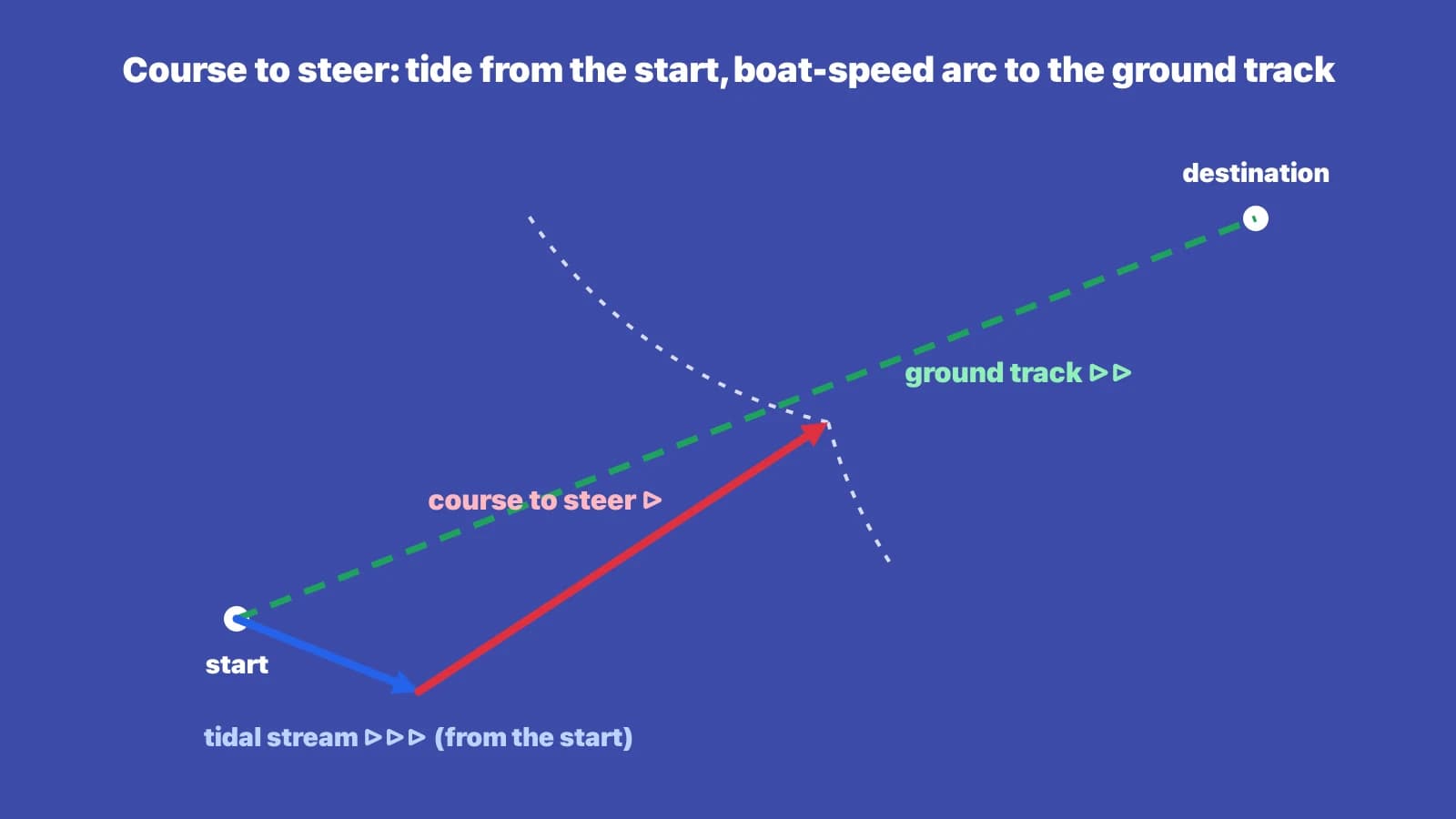
| Plotting a course to steer | Construct the course-to-steer vector triangle for a passage across a tidal stream, with leeway |
| Weather forecasting and meteorology | Read a forecast, recognise fronts, use the Beaufort scale, understand sea breezes and fog |
| Tides | Find the height of tide at a standard and a secondary port from tidal curves; find tidal stream from an atlas or tidal diamonds; springs and neaps |
| Collision regulations | The steering and sailing rules, lights, shapes and sound signals, and how to apply them to a described situation — see our COLREGs guides |
How the assessment works
The RYA's own description is short: the course is 40 hours plus exam time, and the exam must be invigilated at an RYA training centre whichever way the course is delivered. The RYA does not publish a pass mark or the paper format on its public pages, and centres describe their assessments in different ways, so ask yours what to expect. What every version has in common is that you will have to plot on a chart and calculate a height of tide, under some time pressure, using a training chart and almanac extracts — so those are the skills to practise until they are automatic.
The topics that need practice rather than reading
- Tidal heights. Reading the tidal curve, interpolating between springs and neaps, and applying secondary port differences is a procedure, and procedures need repetition. Do a worked example every day for a week.
- Course to steer. The vector triangle for an estimated position (where am I?) is drawn in a different order from the one for a course to steer (where should I point?). Draw both, label both, and note which one starts with the tide.
- True, magnetic and compass. The conversions are simple; the errors come from applying variation or deviation in the wrong direction. Pick one method and use it every single time.
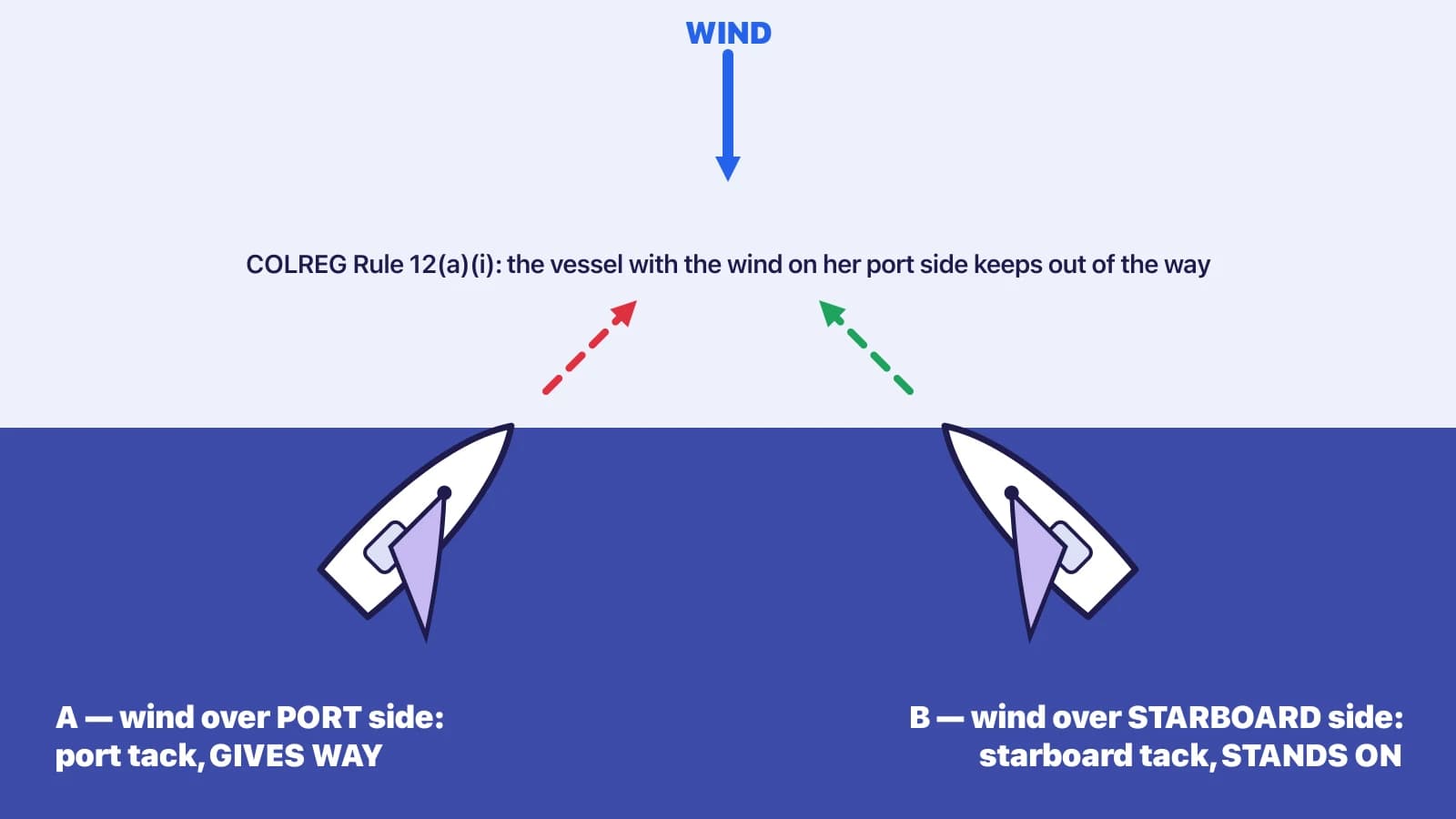
- COLREGs. Not the rules themselves but the exceptions and the roles: when a sailing vessel does not stand on, what the stand-on vessel may and must do, and what makes a vessel an overtaking vessel.
- Lights and shapes. Pure recall, and easiest to fix: little and often beats one long evening.
How to answer a COLREGs question
Rules questions feel ambiguous when you start from “who has priority?”. They stop being ambiguous when you work through the same sequence every time, because the rules themselves are written in that order:
- Identify what each vessel is: sailing vessel, power-driven (including a yacht under engine), not under command, restricted in ability to manoeuvre, engaged in fishing, constrained by draught. The lights or shapes in the question tell you.
- Establish whether the vessels are in sight of one another. If not — fog, radar contact only — Rule 19 applies and there is no give-way or stand-on vessel.
- Check overtaking first. If one vessel is coming up from more than 22.5° abaft the other's beam, Rule 13 applies and she keeps clear, whatever the two vessels are.
- Check whether Rules 9 or 10 apply (narrow channel or traffic separation scheme) and whether Rule 18 ranks the two vessel types.
- Otherwise identify the encounter rule: Rule 12 for two sailing vessels, Rule 14 or 15 for two power-driven vessels.
- State each vessel's responsibilities: the give-way vessel takes early and substantial action (Rule 16); the stand-on vessel keeps course and speed and then acts under Rule 17 when required.
- Only then decide on the specific action, and describe it in the terms the rule uses.
Six-step sequence for applying the steering and sailing rules.
A four-week study plan
This assumes five short sessions a week, about 30 to 45 minutes each, with a longer one at the weekend for chartwork. Adjust the pace to your course dates.
Week 1 — Foundations
- Terminology, parts of the boat, ropework and anchoring.
- Chart symbols and the compass: variation and deviation until the conversions are automatic.
- Weekend: plot positions by latitude and longitude, and by bearing and distance, on the training chart.
Week 2 — Tides
- Tidal theory: springs, neaps, chart datum, drying heights, clearance under a bridge and over a bank.
- Height of tide at a standard port from the curve; then secondary ports.
- Tidal streams from the atlas and from chart diamonds, including interpolation for springs and neaps.
- Weekend: three complete height-of-tide questions, timed.
Week 3 — Chartwork and navigation
- Dead reckoning and estimated position with tide and leeway.
- Course to steer for one hour and for longer passages.
- Position fixing: three-bearing fixes, transits, running fixes; electronic charts and their limits.
- IALA buoyage, cardinal marks and light characteristics.
- Weekend: a full mock chartwork exercise.
Week 4 — Rules, weather, safety, and revision
- COLREGs steering rules, then lights and shapes, then sound signals, using the reasoning sequence above.
- Meteorology: the shipping forecast, fronts and the Beaufort scale.
- Safety and distress, passage planning and pilotage.
- Daily: a mixed quiz across everything, focusing on whatever you got wrong the day before.
On the day
Bring sharp pencils, a soft eraser, dividers, a plotter or parallel rule, and a calculator if your centre allows one. Read every chartwork question twice and write the time and the height of tide next to the plot. For rules questions, run the sequence: what are they, in sight, overtaking, Rules 9/10/18, encounter rule, responsibilities, action. If a question still seems to have two answers, look for the detail you have missed.
Check yourselfA question describes a yacht “motor-sailing with the engine in gear” meeting a yacht under sail alone, on a steady bearing. Which rule decides who keeps clear?Show answer
Rule 18(a). The motor-sailing yacht is a power-driven vessel (Rule 3(c): a sailing vessel is only one whose propelling machinery, if fitted, is not being used), so this is power versus sail and the power-driven vessel keeps out of the way of the sailing vessel — unless she is overtaking (Rule 13) or in a narrow channel or TSS situation (Rules 9, 10). Rule 12 does not apply because only one of them is a sailing vessel.
Key takeaways
- Theory (shorebased) and practical are separate courses with separate certificates; the practical is the one charter companies and the ICC scheme look at, and commercial work needs both plus endorsement.
- The RYA describes the theory course as 40 hours plus an invigilated exam; it does not publish a pass mark. Ask your centre.
- Chartwork, tidal heights and COLREGs are procedures: practise them, do not just read them.
- Answer rules questions with a fixed sequence, never by guessing which vessel “should” have acted.