Every direction in a chartwork problem is expressed relative to one of three norths. True north is the direction of the geographic pole and is what the chart's meridians and outer compass rose show. Magnetic north is where the Earth's field points at your position. Compass north is where your steering compass actually points, which is magnetic north adjusted by the boat's own magnetic effects. Converting between them is a two-step arithmetic that you must be able to do without thinking.
Variation
Variation is the angle between true north and magnetic north at a place. It is named east or west according to which side of true north magnetic north lies. It is printed on the chart's compass rose, with the year and the annual change — for example “4°15′W 2024 (8′E)” means 4°15′ west in 2024, decreasing by 8 minutes a year (an easterly annual change reduces westerly variation). Update it to the current year before using it. Variation is a property of the place, so it is the same for every compass on every boat there, and it changes as you sail across a chart, which is why large charts print several roses.
Deviation
Deviation is the error of your compass caused by ferrous metal and electrical equipment on the boat: the engine, the keel bolts, a loudspeaker mounted too close. It is named east or west and it varies with the boat's heading, because the boat's magnetic field rotates with the boat while the Earth's does not. A compass adjuster reduces it with corrector magnets and records what remains on a deviation card, a table of deviation against compass heading. A well-swung yacht compass has a degree or two; a phone left beside the binnacle can add twenty. Hand-bearing compasses are usually assumed to have no deviation because they are used away from the boat's magnetic influences — an assumption worth testing.
The conversion
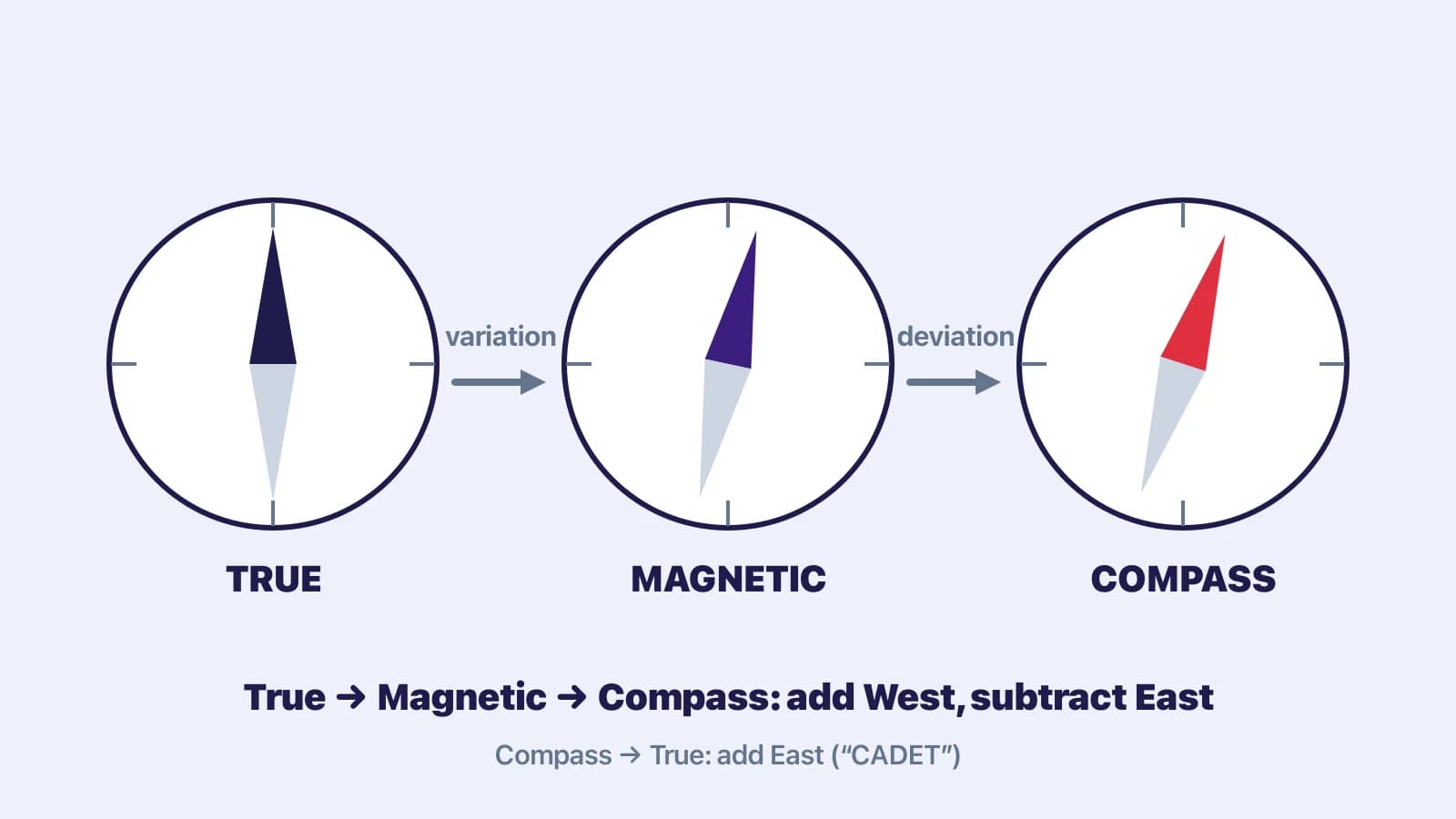
Three boxes, True, Magnetic and Compass, with arrows showing which error is applied between each and the direction in which east is added.
Pick one mental rule and use it every time. Many sailors use “CADET” — Compass ADd East (to get) True — and its mirror: going from true to compass, add west. Others use “West is best, east is least” for the true-to-compass direction (add west, subtract east). The worked examples below use both directions.
Worked example 1: true course to compass course
The chart gives a course of 250°T. Variation is 3°W. Your deviation card gives 2°E on that heading. True to magnetic: add west, 250 + 3 = 253°M. Magnetic to compass: subtract east, 253 − 2 = 251°C. Steer 251° by the steering compass.
Worked example 2: compass bearing to true bearing
You take a bearing of a lighthouse with the steering compass and read 137°C. Deviation on your heading is 3°W; variation is 5°E. Compass to magnetic: subtract west, 137 − 3 = 134°M. Magnetic to true: add east, 134 + 5 = 139°T. Plot 139° from the lighthouse. Note that the deviation used is for the boat's heading, not the bearing.
Practical points
- Label every figure T, M or C. Most errors come from a number with no suffix being fed into the wrong step.
- Deviation is for the boat's heading. When you take a bearing with the steering compass, look up the deviation for the course you are steering, not for the bearing.
- The chart's inner (magnetic) rose already includes the variation printed for that year; if you plot with a magnetic rose you skip the variation step but must still correct the year and apply deviation.
- GPS gives course over the ground, which is true unless you have set the unit to magnetic, and it includes tide and leeway. It is not a heading, and it is not what your compass shows.
- Autopilot and fluxgate compasses have their own deviation and their own calibration procedure; do not assume they match the steering compass.
The common mistake
Applying the rule in the right direction but to the wrong step — adding west when going compass to true, for instance — or applying both errors with the same sign because “they are both west”. The cure is to write the three headings as a column, T–M–C, put the variation between the first two and the deviation between the last two, and move down or up the column one step at a time.
Check yourselfVariation is 6°W and your deviation card shows 1°E on a heading of around 040°C. The course to steer from the chart is 045°T. What do you steer by the compass?Show answer
True to magnetic: add west, 045 + 6 = 051°M. Magnetic to compass: subtract east, 051 − 1 = 050°C. Steer 050°C. (Check that the deviation you used is for the heading you will actually be on; 050°C is close enough to 040°C for a card with 1° entries.)
Key takeaways
- True is the chart; magnetic is the Earth's field at your position (variation); compass is your instrument (deviation, by heading).
- True → magnetic → compass: add west, subtract east. Compass → magnetic → true: add east, subtract west (CADET).
- Read variation from the rose and update it for the year; read deviation from the card for the boat's heading.
- Suffix every number T, M or C, and work one step at a time.