A trimmed sail is a wing. Air flows around both sides, is turned by the curve of the sail, and the turning produces lift — NASA's plain summary is that when a flow is turned one way, lift is generated the other way, and both surfaces contribute. A wing only works while the flow stays attached to its surfaces. Ask too much of it — too large an angle between the wing and the air — and the flow separates into turbulence: stall. Telltales are tufts of yarn or ribbon placed where this happens first. They are not decorations and not a scoring system; they are flow gauges.
Attached flow, separated flow
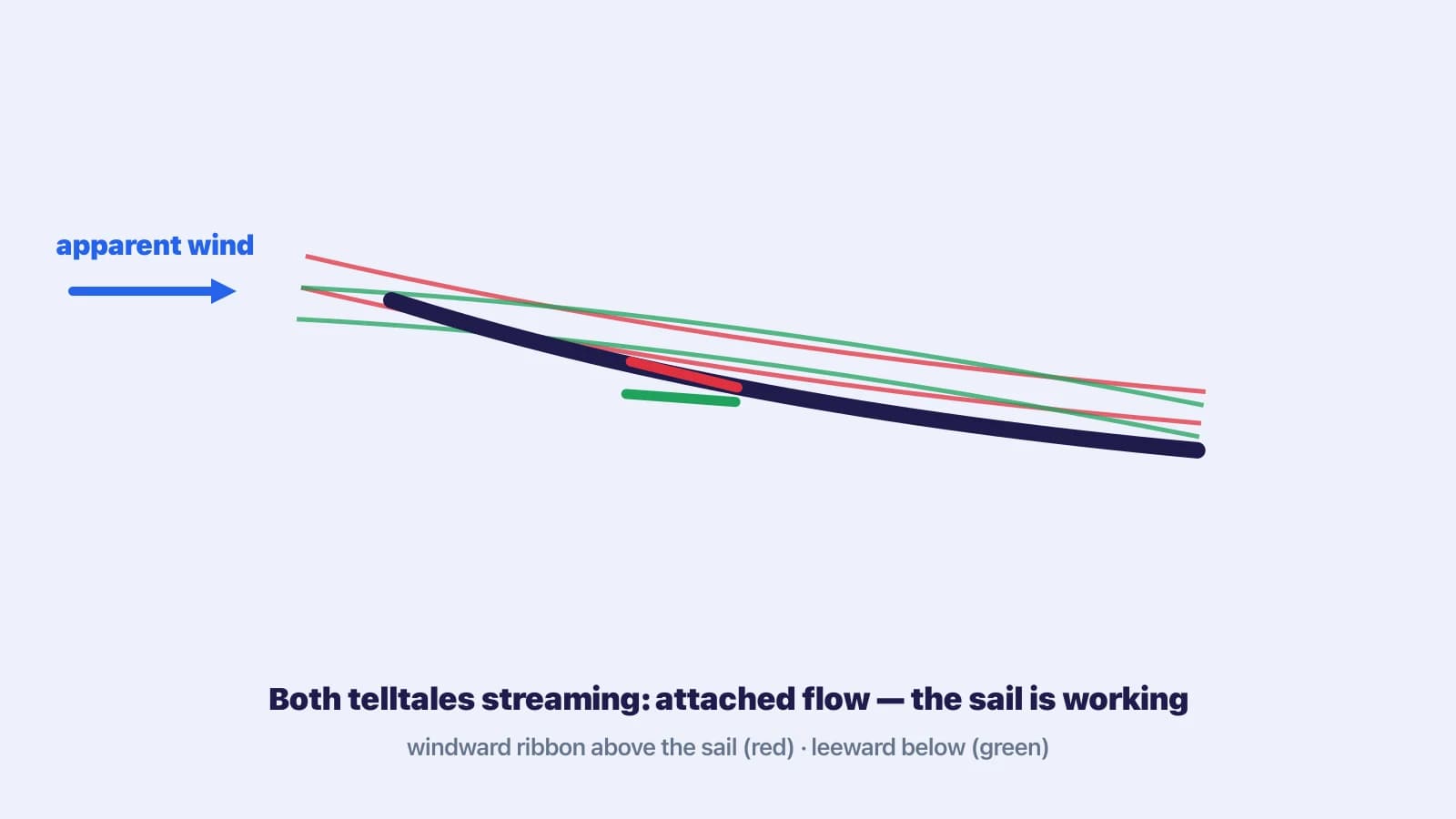
Three sail sections: attached flow with both telltales streaming; too little angle with the windward telltale lifting; too much angle with the leeward telltale stalled.
Two details make telltales click. First, the leeward side matters more: most of a sail's drive comes from the low pressure on the leeward (curved, downwind) side, so a stalled leeward telltale means real lost power even though the sail still looks full — a stalled sail does not flap. Second, separation starts near the luff of a jib, which is why the standard position for telltale pairs is a short way aft of the luff, at several heights.
The four patterns
Table of telltale patterns, their meaning and the corrective action.
- Both streaming aft: attached flow. Correct trim for this course. Do nothing.
- Windward telltale lifting or fluttering: too little angle — the sail is on the edge of luffing. Sheet in, or bear away.
- Leeward telltale stalled (drooping, circling, glued to the sail): too much angle — leeward flow separated. Ease, or head up.
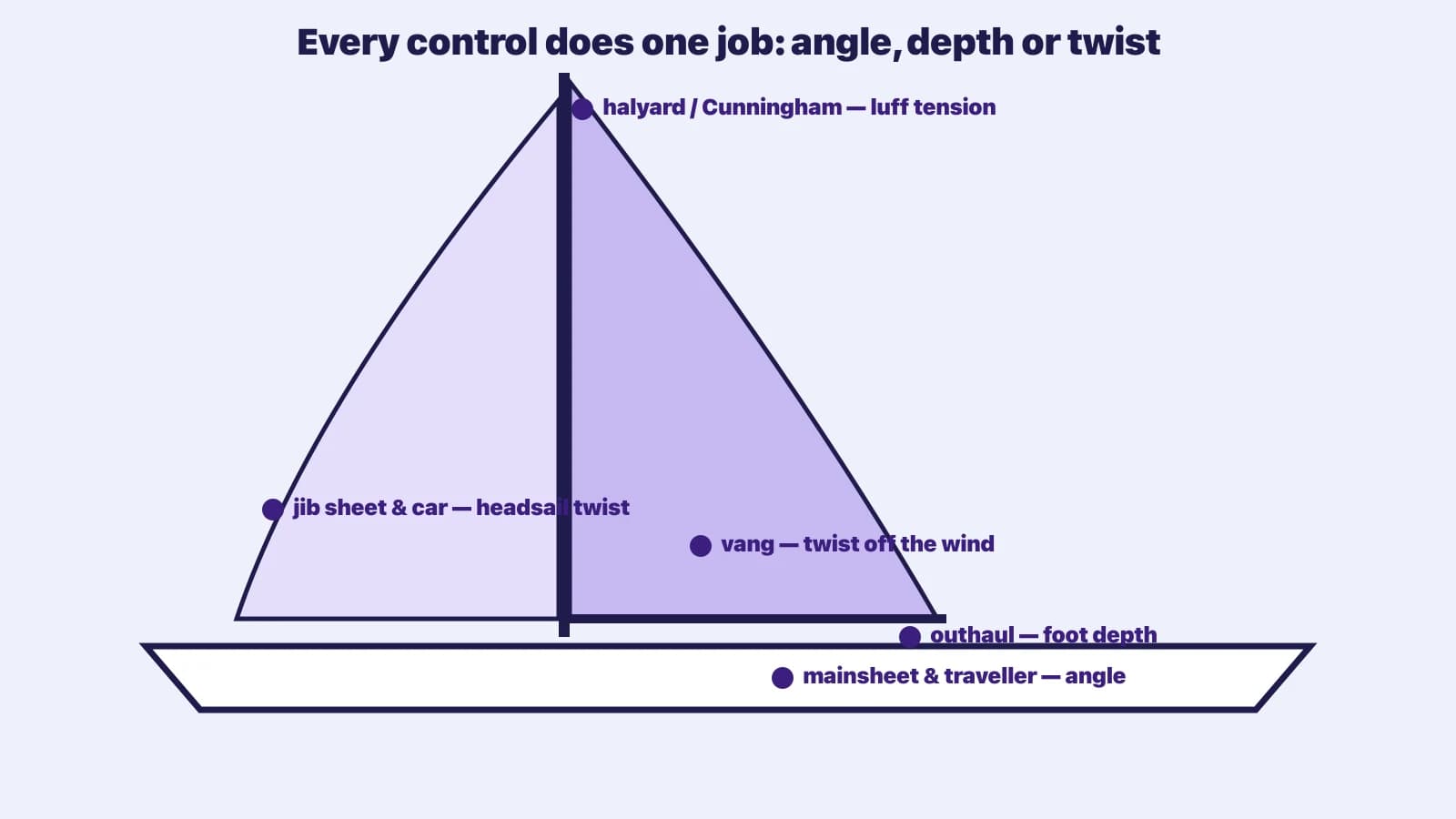
- Top pair misbehaving before the bottom pair: the twist is wrong. Top windward lifting first: too much twist, the head is open — close the leech (jib car forward, or more mainsheet/vang). Top leeward stalling first: not enough twist — open the leech (car aft, ease vang/sheet).
Try it: telltales and angle of attack
Interactive: a slider changes the sail's angle of attack; the telltales stream, lift to windward or stall to leeward, and the readout says whether to trim or steer.
Trim the sail, or steer the boat?
Every telltale error has two corrections, because the angle of attack is set jointly by the sheet and the helm. The rule that untangles it: hold constant whichever matters more right now. Sailing close-hauled to a destination upwind, the sails are already sheeted for the point of sail, so the helm steers to the telltales — windward lifting means you are pointing too high, so bear away a touch; leeward stalling means you can point higher. On a reach with a fixed course to a mark, the course is the constant, so the trimmer works the sheet: ease until the windward telltale just lifts, then trim until it streams. One person changes one thing; the other holds theirs.
Jib telltales, mainsail telltales
- Jib/genoa: pairs near the luff at two or three heights are the primary reference — the jib meets undisturbed air first, and its luff is where separation begins. All the rules above apply directly.
- Mainsail luff telltales are less useful, because the mast disturbs the air arriving at the luff. The main's flow gauge is at the back edge:
- Leech telltales (single ribbons at the batten ends): streaming means flow is leaving the sail cleanly — attached all the way aft. The top leech telltale is the sensitive one: if it hides permanently behind the leech, the top of the main is stalled (over-trimmed or over-vanged); ease sheet or vang until it flies most of the time. If it always streams and the sail luffs early up top, you may have too much twist.
A mainsail with the leech falling off towards the head, apparent-wind arrows angled further aft with height, and leech telltales at the batten ends.
Troubleshooting on the water
What would you do?Everything streams but the boat feels slowClose-hauled, 10 knots apparent. All jib telltales stream, the main's leech telltales stream, but the boat feels sticky and points poorly.Decide, then reveal the reasoning
Streaming telltales mean attached flow, not maximum drive — flow can be attached with the sails too flat, too deep, or under-sheeted so the whole plan makes less power at a wider angle. Check boat-on-boat if you can, then try small experiments: a touch more sheet until the top leech telltale just starts to hide, a look at draft position and halyard tension. Telltales bound the correct trim; inside that band, speed and helm feel are the judges.
What would you do?Beam reach, windward telltales lift no matter whatOn a beam reach the windward jib telltales keep lifting. Sheeting in stops them but the boat heels and slows; the jib car has not been touched since beating.Decide, then reveal the reasoning
The sheet lead is set for close-hauled: with the sheet eased for a reach, the top of the jib opens (twists off) and its windward telltales lift while the bottom is fine. Sheeting harder closes the top but over-trims the bottom — the heel you felt. Move the lead (car forward and/or outboard, or use a barber-hauler) so leech and foot ease together; then trim until top and bottom pairs behave alike. Off the wind, telltale problems are often lead problems, not sheet problems.
Check yourselfClose-hauled, the helm sees the leeward telltales on the jib collapse and swirl. The trimmer's hand is on the sheet. Who does what, and in which direction?Show answer
Leeward stalled means too much angle of attack. If the priority is pointing to windward, the helm heads up a few degrees and the telltales reattach — you were sailing lower than the trim deserved. If the course must be held, the trimmer eases the sheet until the leeward ribbons stream. One correction, not both at once — otherwise you overshoot into a luff.
Key takeaways
- Telltales measure airflow: streaming = attached, lifting windward = too little angle (luffing), stalled leeward = too much (stalled).
- The leeward side is where the power is; a stalled sail looks full and is slow.
- Two cures for every signal — sheet or steer. Hold constant the thing that matters and adjust the other.
- Top vs bottom differences are twist. Fix them with the jib car, vang and sheet tension, not with the helm.
- Leech telltales are the mainsail's flow gauge; the top one should fly most of the time.
- Downwind, flow is detached by design — telltales go quiet, and that is normal.