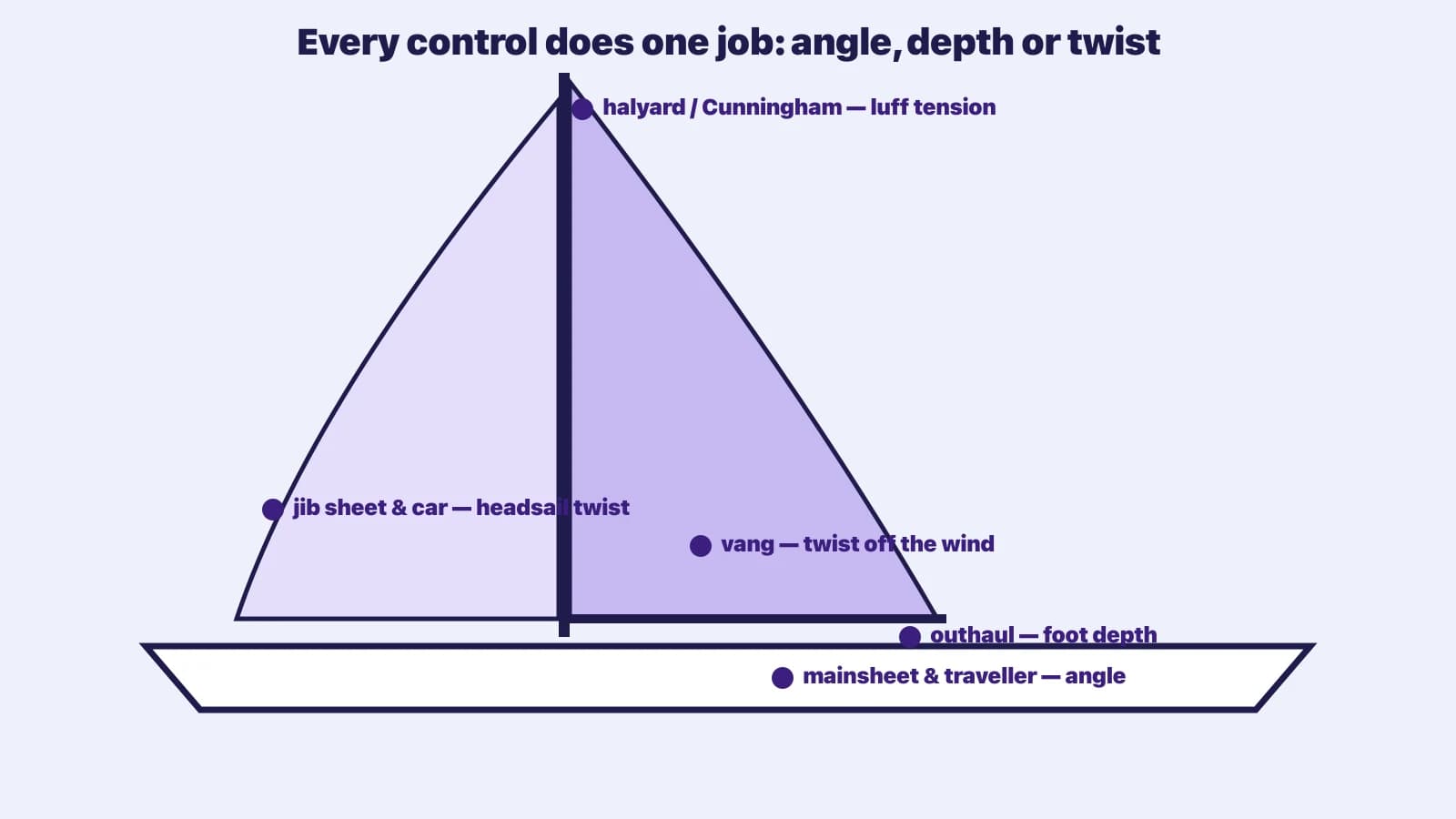
Every mainsail and jib control adjusts one of three things. Angle of attack: how the whole sail meets the apparent wind. Depth (and where the deepest point, the draft, sits): how powerful the wing is. Twist: how the angle changes from foot to head. Power comes from more depth and a closed leech; comfort and control come from less depth and more twist. Hold that frame and each rope below becomes obvious.
A sloop with labels for halyard/Cunningham, outhaul, vang, mainsheet, traveller, jib sheet, jib car and backstay, each with a one-line description of its effect.
Sheets — angle
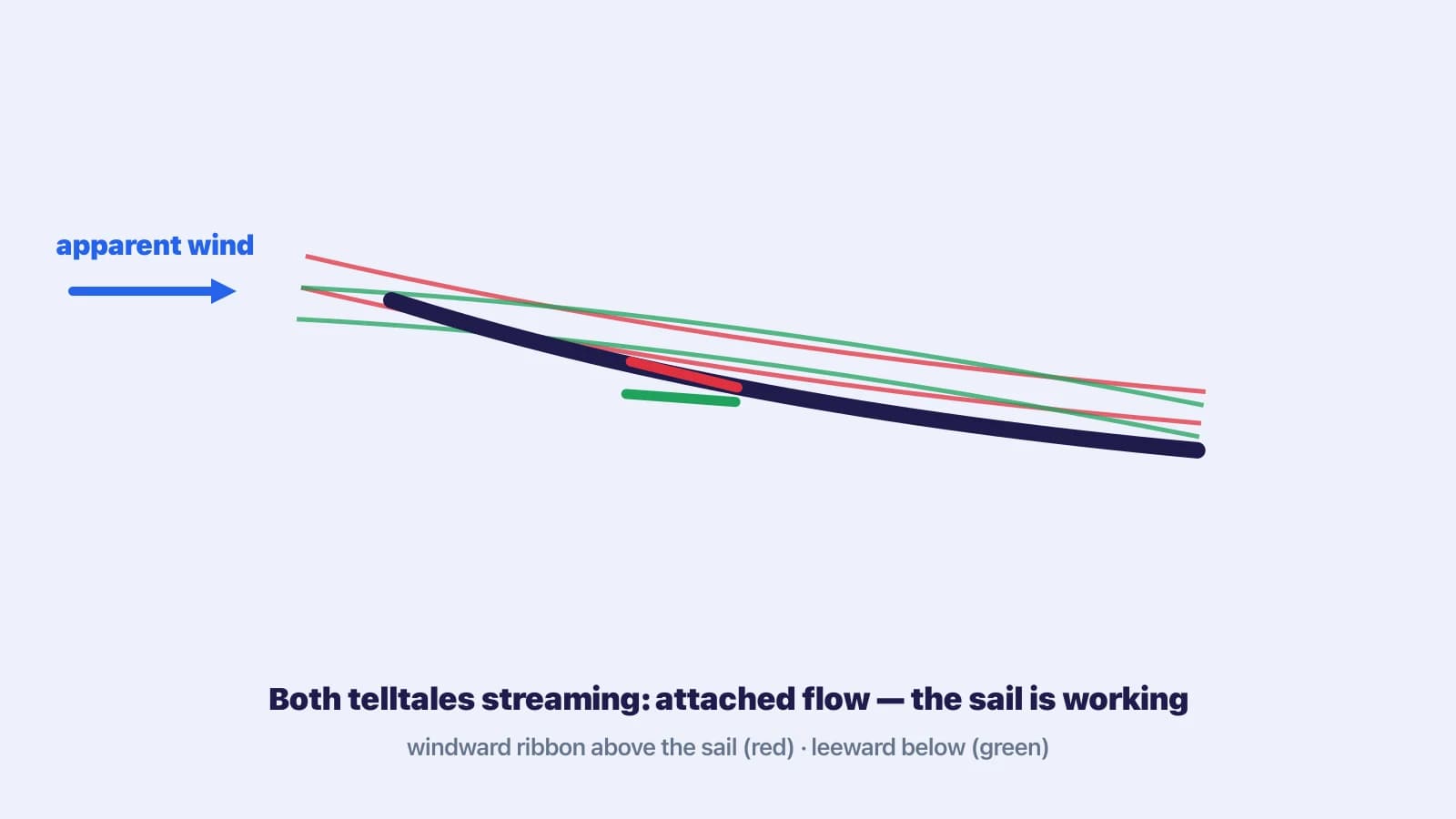
You pull the sheet: the sail comes closer to the centreline. What changes: the angle of attack to the apparent wind — the whole wing rotates. What the boat feels like: trim in and the boat powers up and heels; ease and it stands up and slows (or the sail luffs). When to use: constantly. It is the primary control on every point of sail, and the correct setting is read straight from the telltales — ease until the windward telltale lifts, trim until it streams. Upwind on many boats the mainsheet does a second job: pulled hard, it drags the boom down as much as in, tightening the leech and reducing twist.
Traveller — angle without twist
You slide the mainsheet's attachment point across the boat. What changes: the boom's angle, without changing how hard the sheet pulls down — so the angle of attack changes while the leech and twist stay put. What it feels like: dropping the traveller to leeward in a gust dumps heel instantly and the helm goes light; back up, and the power returns. When to use: upwind in puffy conditions as a fast power valve, and to bring the boom up to the centreline in light air without strangling the leech. No traveller? The vang-plus-sheet combination approximates it.
Vang / kicker — twist off the wind
You tension the tackle from boom to mast base. What changes: the boom stops rising; leech tension is maintained when the sheet is eased, so the top of the main keeps working instead of twisting open. What it feels like: on a reach, vang on turns a flappy, twisted top into drive — and more heel; vang eased lets the top spill in a gust. When to use: any time the sheet is well eased (reaching and running); ease it before a gybe-prone run in heavy air is a matter for the heavy-weather guide. Caution: on a dead run an over-tight vang loads the boom hard against the shrouds and the rig in a broach; on small boats “vang sheeting” is a technique of its own — later.
Outhaul — depth low down
You pull the clew aft along the boom. What changes: the foot flattens, removing depth from the lower third of the main. What it feels like: tight outhaul = flatter, less powerful, less heel, better pointing; eased = fuller, more punch in light air and off the wind. When to use: tighten as the breeze builds and for beating; ease in light air and when reaching. It is the cheapest depower on the boat and beginners forget it exists.
Halyard and Cunningham — where the draft sits
You tension the luff. What changes: the draft moves forward (tension) or drifts aft (ease). As wind builds, sails stretch and the draft creeps aft, which adds heel and weather helm; luff tension pulls it back to roughly 40–45% aft, where the sail is happiest. What it feels like: subtle — horizontal wrinkles off the luff mean too little tension; a hard vertical crease along the luff means too much. When to use: set the halyard so light-air wrinkles just disappear, then add Cunningham as the wind rises. The jib halyard does the same job for the headsail.
Jib cars — the headsail's twist and depth in one
You move the sheet lead block fore or aft. What changes: the direction the sheet pulls. Car forward: more downward pull, tighter leech, less twist, fuller foot. Car aft: more aft pull, tighter foot, opener leech, more twist. What it feels like: with the car right, all the luff telltale pairs break together; car too far aft and the top pair lifts first, too far forward and the top stalls first. When to use: whenever the top and bottom of the jib disagree — especially after easing sheets onto a reach, when moving the car (or adding an outboard lead) fixes what more sheet cannot. This is the answer to the classic “my reach telltales never behave” complaint.
Backstay — only where fitted and adjustable
You tension the wire from masthead to stern. What changes: the mast bends aft in the middle, flattening the mainsail, and the forestay tightens, reducing sag and flattening the jib's entry. What it feels like: a gear change — on hard, both sails flatten and the boat stands up and points; off, everything gets fuller and more powerful. When to use: cruising boats with a simple split or solid backstay can treat it as set-and-forget; if you have an adjuster, on for breeze, off for light air and downwind. It belongs at the end of the list, not the beginning.
A beginner's order of operations
- Course settled? Then sheets, to the telltales. This is 90% of it.
- Top and bottom of the jib disagree? Jib car.
- Eased sheets and the top of the main is flogging open? Vang.
- Too much heel and helm as the breeze builds? Flatten: outhaul, then luff tension, then traveller down (then reef — see the reefing guide).
- Light and sticky? Fuller: ease outhaul, ease halyard to just-wrinkles, traveller up, a touch of twist.
| Control | What changes in the sail | First reach for it when… |
|---|---|---|
| Sheet | Angle of attack (upwind main: also leech) | Always — trim to the telltales |
| Traveller | Angle without changing twist | Gusty beats; light-air pointing |
| Vang / kicker | Leech tension / twist with sheet eased | Reaching and running |
| Outhaul | Depth of the lower main | Breeze building; beating |
| Halyard / Cunningham | Luff tension → draft position | Wrinkles, or draft blown aft in breeze |
| Jib car | Headsail twist vs foot depth | Top and bottom telltales disagree |
| Backstay (adjustable) | Mast bend and forestay sag → overall depth | Big wind-range changes |
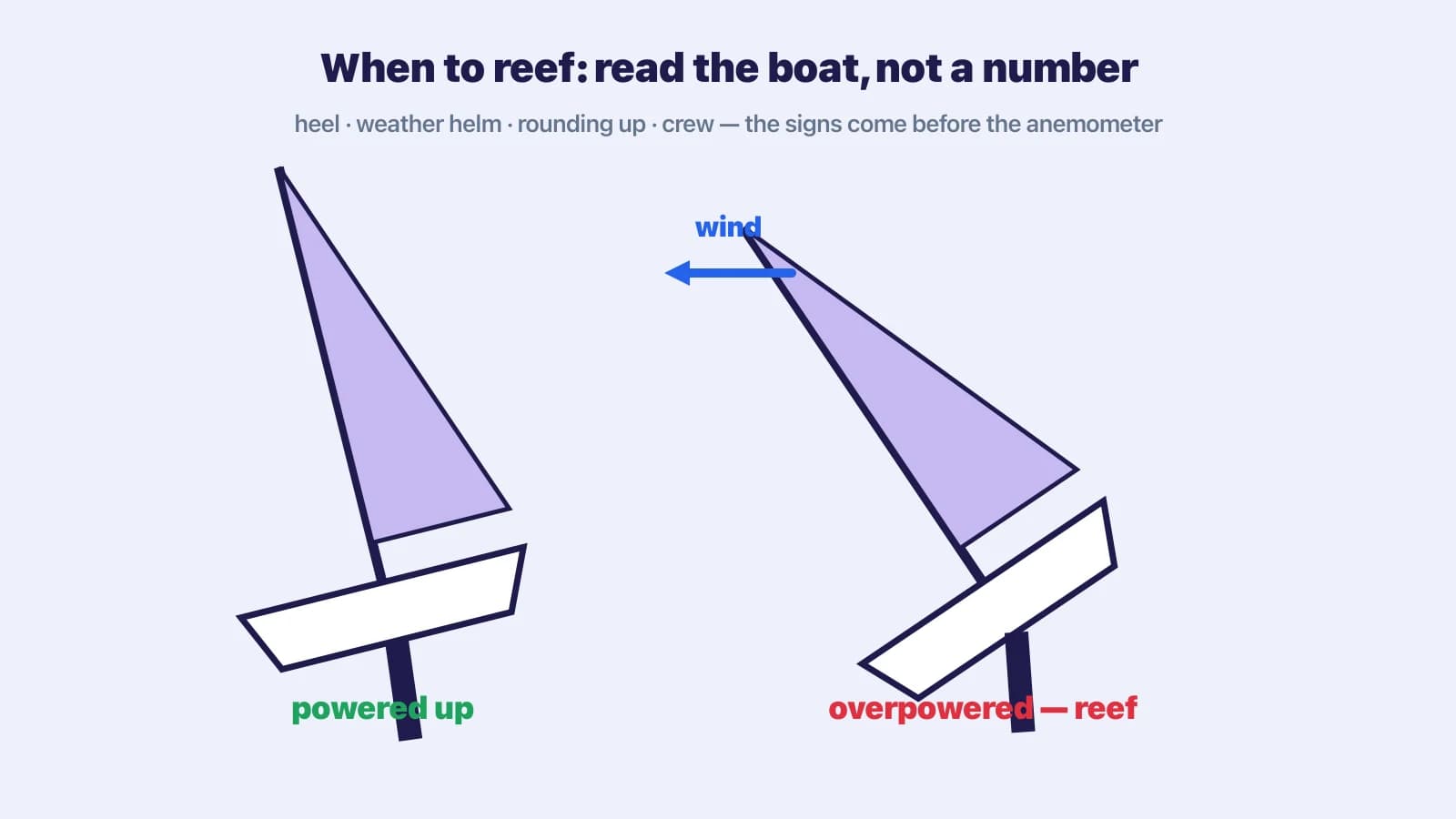
What would you do?The building afternoon breezeYou set off close-hauled in 10 knots, everything trimmed and happy. Two hours later it is 18 knots; the boat heels to 25°, gripes into every gust, and the helm is heavy. The crew's instinct is to pull everything tighter.Decide, then reveal the reasoning
Heavy weather helm plus heel means the sail plan is over-deep and the draft has blown aft — the boat needs flattening, not more sheet. Outhaul hard on; Cunningham on until the draft is back forward; traveller down a few inches so gusts spill; if fitted, backstay on. Telltales should still stream. If the helm is still heavy, that is the boat asking for a reef — which is the next guide. “Pull everything tighter” is right for the flattening controls and wrong for the sheet, which is why naming the controls' jobs matters.
Check yourselfOn a beam reach you ease the mainsheet until the boom is well out, and the top third of the main immediately twists open and flogs while the bottom still draws. Which control fixes this, and why not the sheet?Show answer
The vang. With the sheet eased, its downward component is gone, the boom lifts, and the leech opens aloft — classic reaching twist-off. Sheeting back in would close the top but over-trim the whole sail for the course. Tension the vang until the top leech telltale flies and the upper luff telltales match the lower ones; the sheet then controls only the angle.
Key takeaways
- Three ideas: angle (sheet, traveller), depth (outhaul, luff tension, backstay), twist (vang, jib car, sheet tension).
- Sheets first, always, read from the telltales. Then the twist controls. Then the shape controls.
- Power up for light air (fuller, less twist); depower for breeze (flatter, more twist, traveller down) — before reefing.
- The jib car is the fix for reaching telltale trouble; the vang is the fix for a twisted-open main off the wind.