Reefing means reducing sail area — folding or rolling away part of the mainsail, rolling up part of the headsail, or changing to a smaller sail. The question is never whether your boat can reef; it is when. Forums are full of people asking for the number, and the truthful answer is that the boat tells you, earlier and more reliably than the anemometer. This guide teaches you to read it.
What overpowered looks like
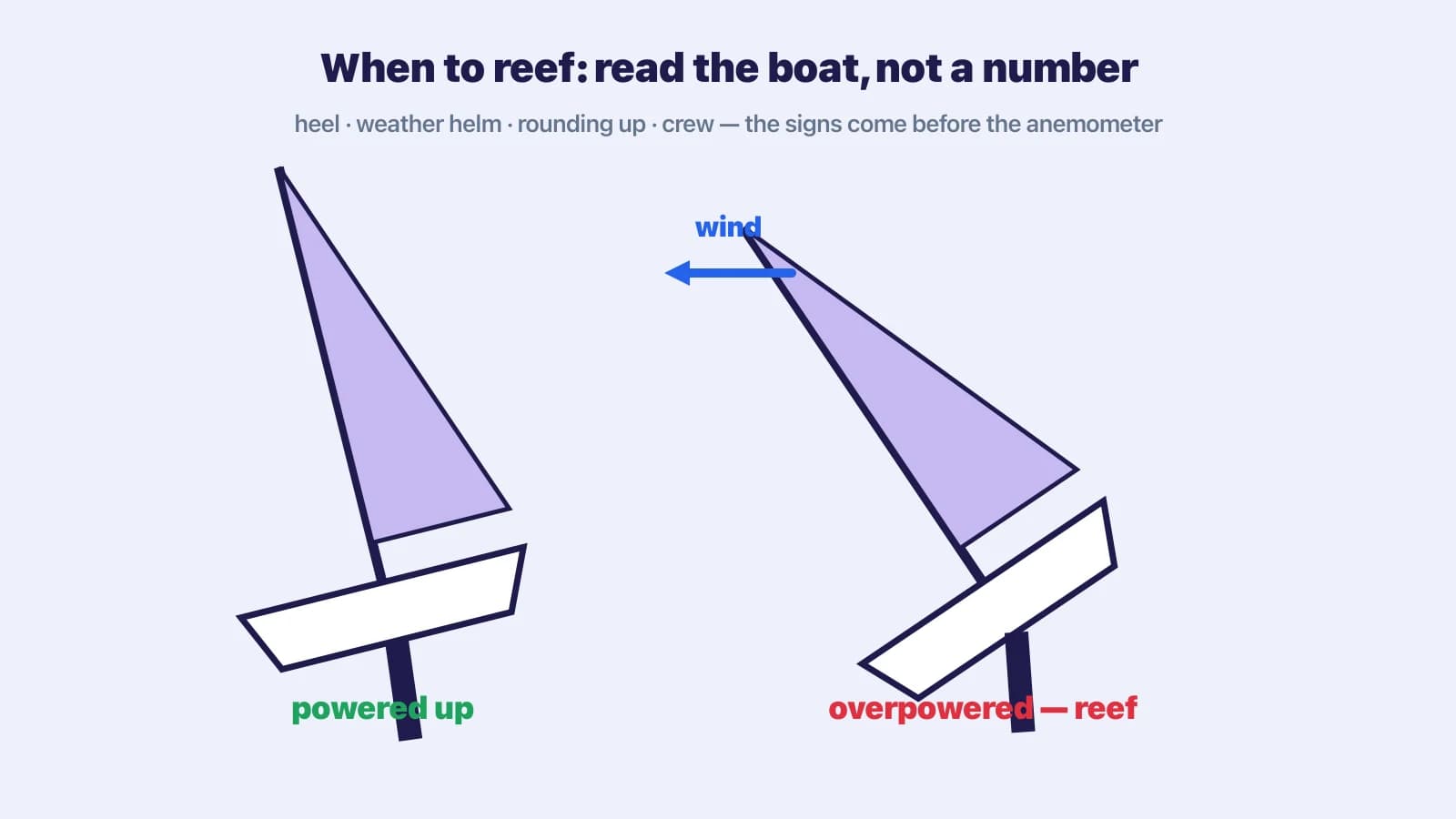
Two boats from astern: moderate heel with a centred rudder versus excessive heel with heavy rudder angle and spilling sails.
- Heel beyond the boat's happy angle — for many cruisers something like 15–25°, and you learn yours quickly. Persistent burying of the leeward rail is past it.
- Heavy weather helm: you are holding the tiller or wheel against a constant pull to windward, and the rudder is visibly angled to hold course. A few degrees of weather helm is healthy; a fight is not.
- Rounding up in gusts: the boat overpowers the rudder and screws into the wind despite you.
- You are easing or dumping the mainsheet or traveller continuously to keep control — you are already sailing on reduced power, just inefficiently and noisily.
- Steering feels like work, the boat slams and staggers, speed is not rising with the gusts.
- The crew: white knuckles, quiet passengers, a helm getting tired. An overpowered boat with a nervous crew is a decision already made.
- What is coming: a building forecast, a squall line to windward, dusk, or a lee shore. Reef for the conditions ahead, not the conditions now.
Before the reef: the depower ladder
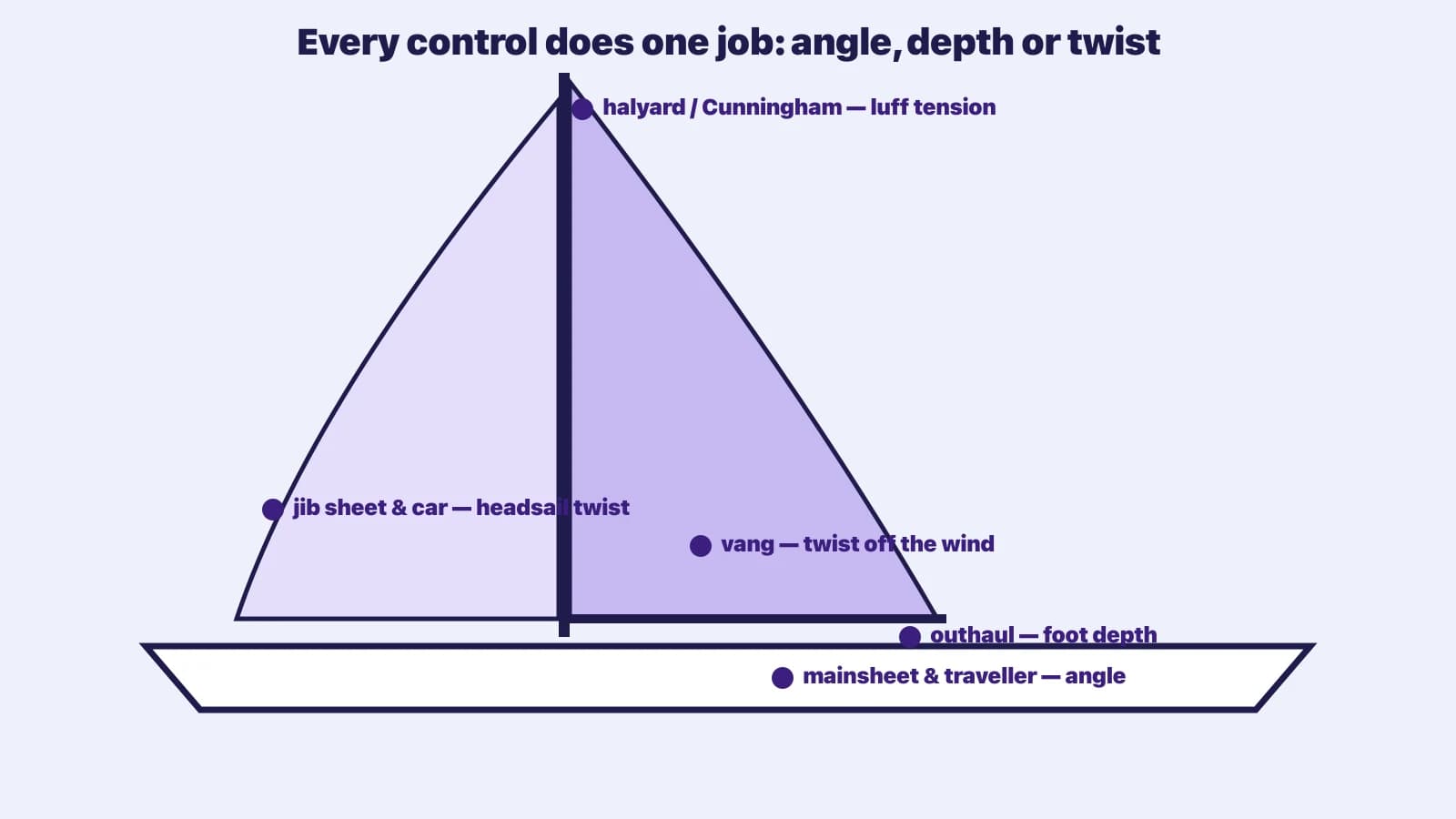
Reefing is a step on a ladder, not the first rung. As the breeze builds: flatten the sails (outhaul, luff tension, backstay), add twist to spill the top (vang and sheet, jib car aft), drop the traveller, and feather slightly closer to the wind in gusts. When you are doing all of that and the signs persist — that is the reef. The ladder also runs in reverse for shaking out. Our sail-trim guide covers each control.
What to reduce, and in what order
- First reef in the main: on most modern boats this is cheap — the boat stands up, the helm lightens, speed barely changes. Slab/jiffy reefing pulls the sail down to a new tack and clew; in-mast or in-boom furling rolls it away.
- Headsail rolls: a few turns of the furler flatten and shrink the genoa. Deep-rolled furling genoas set badly (baggy and draft-aft), so big reductions are better done in stages with the lead moved forward, or by changing to a smaller sail if you can.
- Second and third reefs: same logic, bigger steps. If you are asking whether the second reef is needed, the saying applies again. Many cruisers rig the second reef's lines before a forecast rough passage so it is one pull.
- Balance check after every change: helm should be light with a touch of weather feel. Gripes to windward → take more from the main; flops to leeward or the bow won't come up → take more from the headsail.
- Rig differences: fractional rigs with small jibs live on their mainsails — reef the main early. Masthead rigs with overlapping genoas often shorten headsail first. Cutters can drop to staysail and reefed main, a famously balanced heavy-weather plan. Catamarans do not heel to warn you — reef by the numbers and forecasts, earlier than feel suggests.
The apparent-wind trap
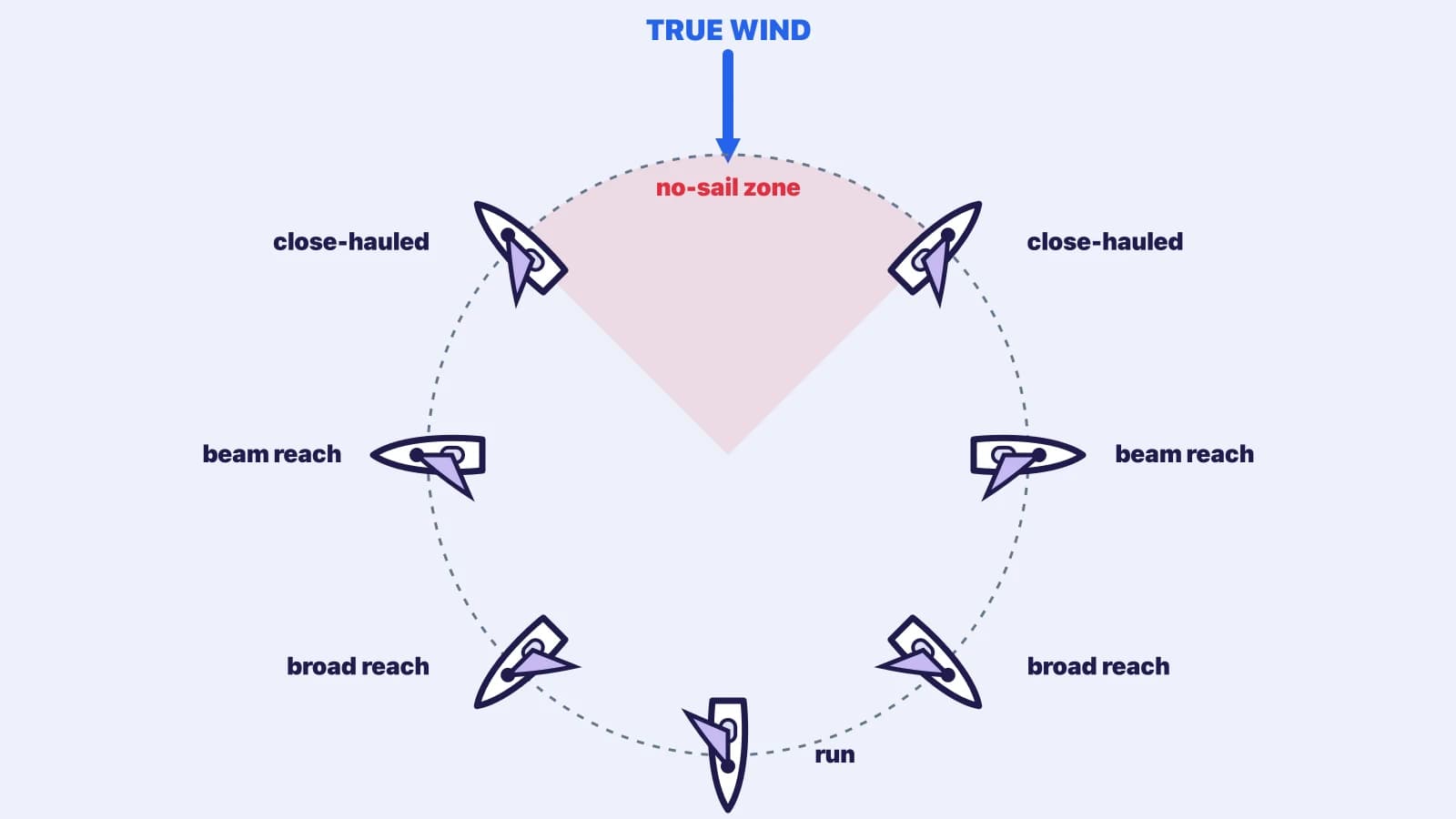
The same true wind makes utterly different apparent wind on different courses: 18 knots true is roughly 12–13 apparent on a broad reach at 6 knots and around 23 close-hauled. This is why the classic mistake happens downwind: everything feels gentle, then you round up for home and the boat is suddenly on her ear. Before turning upwind, or before a gybe in breeze, do the sum and reef first — reefing on a run is awkward on many boats (the main is pressed against the rig), so the moment to act is before the turn. Squalls deserve the same thinking: reef before the cloud arrives.
Procedure: principles that travel between boats
- Set up so you can reef the main without heading dead upwind: ease the sheet and vang, take the load off the sail (a close reach or heaving-to works on many boats), and know where the halyard marks are.
- Reduce load before you pull: luff tension off the sail makes the pennant winchable by hand.
- Secure the new tack and clew first; the loose bunt of sail and the tidy-up ties carry no load and can wait. Never let a reefing tie take sail load — that tears sails.
- Practise in 10 knots, twice, until the crew can do it without discussion. The details — lines, hooks, order — are your boat's, and no article replaces doing it. ASA 103 examines exactly this: reef under way, then shake it out.
What would you do?The forecast that grewYou are beating home, 8 miles to go, full main and genoa in 14 knots, heeling 20° with a firm but manageable helm. The forecast said 12–16; the sky to windward is darkening and the gusts are now 18. Crew: you, plus one nervous beginner.Decide, then reveal the reasoning
Three signs are already present: heel at the top of the comfortable range, building gusts beyond forecast, and a crew member whose confidence is part of the safety margin. Beating means the apparent wind is maximal, and it will rise further in the gusts. Reef now — first reef in the main, a few rolls of genoa, done in two calm minutes while the deck is still dry. If the darkening sky comes to nothing you lose ten minutes; if it delivers 25 knots you are already configured, and your beginner spends the squall learning that sailing is undramatic.
Check yourselfBroad-reaching in 20 knots true at 7 knots boat speed, the boat feels docile under full sail. In 30 minutes you must round a headland and beat the last 3 miles. What is the apparent wind now, roughly what will it be close-hauled, and what should you do?Show answer
Now: roughly 20 − 7 ≈ 13–14 knots apparent — hence the docility. Close-hauled at, say, 6 knots: roughly low-to-mid 20s apparent, plus more in gusts. That is reefing weather for most cruisers. Reef before the headland, while the motion is easy and the main can be handled — reefing mid-tack off a headland in 24 apparent with a pressed crew is exactly the situation the old saying exists to prevent.
Key takeaways
- No official body publishes a reef-at-X-knots rule; treat any number as a local rule of thumb. The boat's signs are the standard: heel, weather helm, rounding up, constant dumping, crew state, and what is coming.
- Depower first (flatten, twist, traveller), reef when the signs persist. Reef early: it is cheap insurance that usually makes you faster.
- Reduce towards balance: main for weather helm, headsail for lee helm; first reef + a few genoa rolls suits many boats.
- Mind apparent wind: downwind comfort hides upwind reality. Reef before turning upwind, before squalls, before dark.
- Procedures are boat-specific. Learn yours in light air, on purpose.